How To Win More Supporters & Donors Online with AI Marketing

Winning supporters and donors online is not about shouting louder. It is about helping the right people understand your mission, trust your organization, and take a clear next step.
People may discover your nonprofit through Google, social media, email, AI search tools, YouTube, partner websites, influencer content, or a friend’s recommendation. What they see next matters.
Your website, donation page, impact stories, emails, social posts, and follow-up messages all work together to shape whether someone gives, volunteers, subscribes, shares, or leaves.
AI can help nonprofit teams create content faster, personalize supporter journeys, summarize campaign data, write stronger first drafts, and repurpose one story across multiple channels. But the heart of online donor engagement is still human: trust, clarity, empathy, proof, and a real reason to care.
Many organizations are not using the web enough to promote their nonprofits.
The web has created lots of opportunities in various industries in the last decades.
It’s sad to say that the nonprofit industry hasn’t benefited so much from the adoption of the web.
And here’s the reason:
The charity sector lacks enough marketers who specialize in nonprofit marketing.
If you’re planning to volunteer to help or work for a nonprofit organization as a digital marketer, this article will help you get started.
Chapters

Why Online Supporter Engagement Matters for Nonprofits
Most supporters begin their relationship with a nonprofit online.
They may visit your website before donating. They may check your social media before volunteering. They may read a blog post before subscribing. They may search your organization before recommending you to a company, church, school, or foundation.
That means your online presence needs to answer important questions quickly:
- Who do you help?
- What problem do you solve?
- Why does it matter?
- How can people trust you?
- What impact have you created?
- How can someone help right now?
- What happens after someone donates?
- How can people stay involved?
If those answers are unclear, people hesitate.
If those answers are easy to find, people are more likely to act.
Online supporter engagement is not only about marketing. It is about making your mission understandable, credible, and easy to support.
Start with a Clear Mission Message
Before asking for donations, make sure people understand your mission.
A strong mission message should be simple enough for someone to repeat.
Avoid vague wording like:
“We empower communities through holistic solutions.”
Use clearer language:
“We help local families access fresh food every week.”
Or:
“We provide free tutoring and mentorship for students who need extra support.”
Your website, donation page, social profiles, email welcome sequence, and campaign content should all make the mission clear.
A strong message usually includes:
- Who you serve
- What problem you address
- How you help
- Why it matters
- How supporters can join
When your mission is clear, every campaign becomes easier.
Build Trust Before Asking for Donations
People give when they trust you.
Before someone donates online, they may look for signals that your nonprofit is real, active, responsible, and transparent.
Trust signals include:
- Clear donation page
- Secure payment process
- Real impact stories
- Recent updates
- Team or leadership information
- Contact details
- Financial transparency
- Annual reports
- Partner logos
- Testimonials
- Media mentions
- Volunteer stories
- Privacy policy
- Consistent branding
- Active social media
- Clear thank-you process
Do not make donors guess where their money goes.
Show examples like:
€25 helps provide meals for local families
€50 supports school materials for students
€100 helps fund emergency supplies
Monthly gifts help us plan long-term support
Specific giving examples help people connect money to impact.
Use AI to Strengthen Nonprofit Marketing Workflows
AI can help nonprofits create more content with less pressure, especially when teams are small.
AI can support:
- Donor email drafts
- Social media captions
- Blog outlines
- Campaign headline ideas
- Donation page copy
- Volunteer recruitment posts
- Newsletter summaries
- Impact story repurposing
- FAQ drafts
- Video script ideas
- Thank-you message variations
- Audience-specific campaign versions
- Survey response summaries
- Content calendars
- Performance reports
For example, one impact story can become:
- A donor email
- A blog post
- A LinkedIn post
- An Instagram caption
- A Facebook update
- A short video script
- A newsletter section
- A donation page quote
This saves time and keeps your message consistent.
AI should speed up the work, not replace human review. Always check facts, tone, names, numbers, donor privacy, and impact claims before publishing.
Create Donor Journeys, Not One-Time Asks
Many nonprofits focus too much on the donation ask and not enough on the donor journey.
A strong online donor journey includes:
- Discovery
- Education
- Trust-building
- Donation
- Thank-you message
- Impact update
- Follow-up story
- Invitation to stay involved
- Recurring giving opportunity
- Long-term relationship building
Someone who donates once should not disappear into a database.
After a donation, send a warm confirmation, then follow up with proof of impact. Show what happened because people gave.
A simple donor journey could look like this:
Day 1: Thank-you email
Day 7: Impact story
Day 21: Program update
Day 45: Invitation to follow on social media
Day 60: Monthly giving invitation
Day 90: Donor survey or feedback request
This turns one-time giving into relationship-building.
Improve Your Donation Page
Your donation page is one of the most important pages on your nonprofit website.
A strong donation page should be:
- Easy to find
- Mobile-friendly
- Fast-loading
- Secure
- Simple to complete
- Clear about impact
- Focused on one main action
- Free of unnecessary distractions
Include:
- Clear headline
- Short campaign explanation
- Suggested donation amounts
- Recurring giving option
- Trust signals
- Simple form fields
- Secure payment indicators
- Impact examples
- Privacy reassurance
- Thank-you confirmation
Avoid long paragraphs, confusing forms, too many links, or unclear payment steps.
If people are ready to give, make the process smooth.
Use Storytelling to Make the Mission Real
Facts matter, but stories help people feel the mission.
A good nonprofit story shows:
- A real problem
- A person, group, or community affected
- The role of the nonprofit
- The role of supporters
- The change created
- The next action needed
A story does not need to be dramatic to be powerful. It needs to be clear, respectful, and specific.
For example:
“Last month, our volunteers packed 800 food boxes for families in the community.”
Or:
“After joining our mentorship program, students gained consistent weekly support and a safe place to ask questions.”
Protect dignity and privacy. Avoid using stories that exploit pain or pressure people into giving through guilt.
The strongest nonprofit storytelling creates empathy, trust, and action.
Use SEO to Attract Supporters Who Are Already Searching
SEO helps people discover your nonprofit when they search for answers related to your mission.
A nonprofit can use SEO to reach people searching for:
- How to help with a cause
- Where to volunteer locally
- How to donate to a specific issue
- What a nonprofit does
- How a social problem works
- Ways companies can give back
- Community support resources
- Fundraising campaign ideas
- Volunteer opportunities
- Impact stories
- Educational guides
Your website should include pages and blog posts that answer these questions.
Useful nonprofit SEO content includes:
- Cause education posts
- Volunteer guides
- Donor FAQs
- Program pages
- Impact stories
- Campaign pages
- Local resource pages
- Corporate partnership pages
- AI marketing and digital fundraising guides
- Event pages
- How-to articles
SEO works best when content is genuinely helpful. The goal is not just traffic. The goal is attracting people who are more likely to care, trust, and act.
Turn Website Visitors into Supporters
Not every website visitor will donate immediately. Give people smaller ways to stay connected.
Useful conversion options include:
- Email newsletter sign-up
- Volunteer interest form
- Event registration
- Free resource download
- Petition signature
- Social media follow
- Impact report download
- Webinar sign-up
- Community group invitation
- Corporate partnership inquiry
- Monthly donor information page
A visitor who is not ready to donate today may become a supporter later.
Make the next step clear on every important page.
Examples:
- Subscribe for monthly impact updates
- Join our volunteer list
- Download our impact report
- See how donations help
- Share this campaign
- Become a monthly supporter
- Partner with us
Clear calls to action help people move from interest to involvement.
Use Email to Build Long-Term Support
Email is still one of the most valuable channels for nonprofit donor engagement.
Social media is useful, but email gives you a more direct way to build relationships.
Use email to send:
- Welcome sequences
- Campaign updates
- Impact stories
- Donor thank-you messages
- Volunteer opportunities
- Event invitations
- Monthly newsletters
- Advocacy alerts
- Program updates
- Fundraising appeals
- Year-end updates
- Survey requests
A strong nonprofit email should have one clear purpose.
Do not only email when asking for money. Share gratitude, progress, stories, and helpful updates.
AI can help draft email variations, subject lines, summaries, and audience-specific messages. Your team should still make the final message personal and accurate.
Use Social Media to Build Community
Social media helps nonprofits stay visible and approachable.
Use it to:
- Educate people
- Share impact stories
- Thank supporters
- Promote campaigns
- Recruit volunteers
- Show behind-the-scenes work
- Highlight partners
- Share staff and volunteer voices
- Answer common questions
- Celebrate milestones
- Drive traffic to your website
- Invite people to events
Social media works best when it feels human.
Instead of only posting polished announcements, show the people and process behind the mission. Share what volunteers are doing. Explain what donations help fund. Celebrate small wins. Answer questions simply.
Use AI to create caption drafts and repurpose blog posts, but keep the final content natural and specific.
Personalize Supporter Communication
Not every supporter should receive the same message.
A first-time donor, monthly donor, volunteer, corporate partner, newsletter subscriber, and event attendee may all care about your mission for different reasons.
Personalization can improve engagement by making messages more relevant.
You can personalize by:
- Donation history
- Volunteer interest
- Event attendance
- Program interest
- Location
- Email engagement
- Campaign participation
- Corporate partnership interest
- Content downloads
- Giving frequency
For example:
New donors receive a welcome journey
Monthly donors receive long-term impact updates
Volunteers receive upcoming opportunities
Corporate contacts receive partnership content
Newsletter subscribers receive educational stories
AI can help create message variations for each group, but supporter data should be handled carefully and respectfully.
Use Video to Win Attention and Trust
Video can help nonprofits explain emotion, urgency, and impact quickly.
Useful nonprofit video ideas include:
- Short impact stories
- Volunteer day recaps
- Founder message
- Donor thank-you video
- Campaign explainer
- Behind-the-scenes update
- Program tour
- Beneficiary story with consent
- Partner spotlight
- Event recap
- Educational short
- Myth-busting video
- Donation impact video
Short videos can be used on YouTube Shorts, Instagram Reels, TikTok, LinkedIn, Facebook, email, and campaign pages.
AI can help with video scripts, hooks, captions, and repurposing long stories into short formats.
The best nonprofit videos do not need to be overproduced. They need to be clear, honest, and emotionally grounded.
Make Online Giving Feel Safe
Supporters need to feel safe before entering payment details.
Your digital giving experience should include:
- HTTPS
- Trusted payment processor
- Clear nonprofit name
- Secure donation form
- Privacy policy
- Contact details
- Donation confirmation
- Clear refund or support information
- Transparent recurring gift options
- No confusing checkout steps
- Mobile-friendly layout
Also be clear about how donor data is used.
Trust is easier to build than repair. Make safety and transparency visible.
Use Retargeting and Follow-Up Carefully
Some supporters need more than one touchpoint before they act.
Retargeting and follow-up campaigns can remind people about your mission after they visit your website, view a campaign page, or engage with your content.
Use these tactics responsibly.
Good follow-up messages feel helpful:
“You can still help fund this campaign.”
“See the impact of this month’s giving.”
“Volunteer spots are still open.”
“Read the story behind the campaign.”
Avoid messages that feel invasive, guilt-driven, or manipulative.
Nonprofit marketing should encourage action while respecting the supporter.
Measure What Actually Matters
Online growth is not only about followers or page views.
Track metrics connected to real supporter action.
Useful metrics include:
- Website visitors
- Donation page conversion rate
- Email sign-ups
- Email open rate
- Click-through rate
- Donation amount
- Recurring donor growth
- Volunteer sign-ups
- Event registrations
- Social shares
- Campaign landing page visits
- Donor retention
- Cost per donation
- Newsletter growth
- Content engagement
- Search traffic
- Video watch time
- Partner inquiries
For nonprofit AI marketing workflows, also track time saved, content output quality, and campaign performance.
The goal is to understand which activities lead to trust, action, and long-term support.
Online Supporter Growth Checklist
Use this checklist to improve your online supporter journey:
- Your mission is clear within seconds
- Your donation page is easy to find
- Your website is mobile-friendly
- Your impact stories are recent
- Your email sign-up is visible
- Your volunteer page is clear
- Your calls to action are specific
- Your social media supports your campaigns
- Your blog answers real supporter questions
- Your donor thank-you flow is warm
- Your AI-generated content is reviewed
- Your supporter data is handled carefully
- Your SEO pages target useful topics
- Your donation process feels safe
- Your campaigns include follow-up messages
- Your metrics track action, not vanity
Winning supporters online is not one tactic. It is the result of a clear, trustworthy, and helpful digital experience.
Start telling stories through content marketing
Nonprofits are still way behind when it comes to implementing content marketing as a way of getting the attention of potential supporters and donors.
Most charity organizations rely heavily on print than the internet.
We’ve been witnessing the slow death of print over the past few years.
Just last year, we saw The Independent became the first national newspaper to close and focus on digital-only publishing.
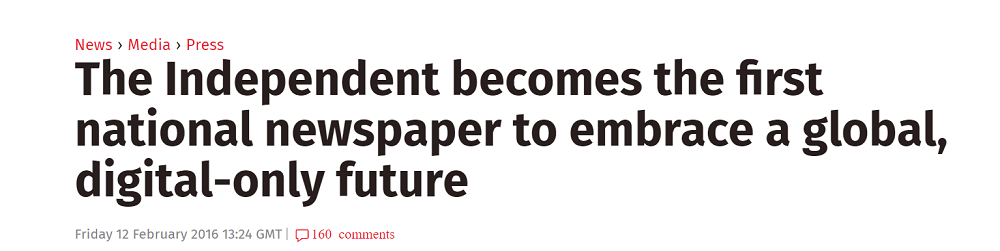
In fact, research showed that some 198 UK local newspapers have closed since 2005.
Newspapers are the most commonly used channel for nonprofits.
Digital has changed everything.
Nonprofits need to rethink how they create awareness for their cause.
There’s only one way forward:
Content marketing.
With content marketing, instead of charities posting their adverts on newspapers, they have to become publishers themselves.
They have to own their platforms where people learn about their cause and support them.
A nonprofit should set up a website and a blog that drives people from search engines and social media.
For example, the National Alliance on Mental Illness Organization has a blog and they update it on a regular basis.
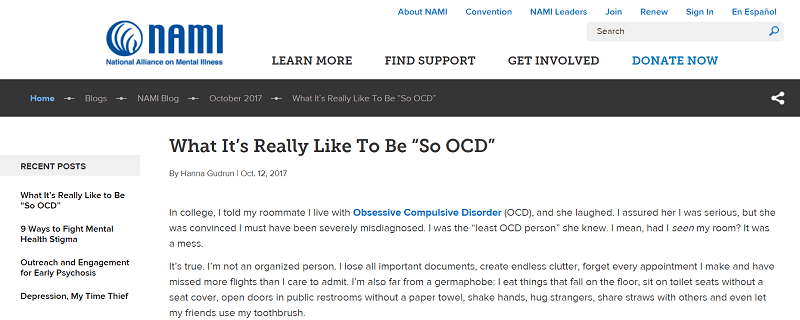
Publishing blog posts that educate victims, supporters and donors will help drive awareness for the organization.
NAMI created another blog post that originates from a discussion their fans had in their Facebook community.
The post was titled “What Does It Mean to Have a Mental Illness?”
These are all content.
Instead of using a newspaper to get their story out there in the world, NAMI has become its own publisher.
Every nonprofit should start a blog where they publish their own stories.
Build a presence on social media
Your nonprofit should also build a solid presence on social media to extend its reach.
Updates about causes spread very fast on social media because people want to help those in need. They want to be part of something special.
The average Facebook user has 338 friends.
Just imagine you can get 100 people to like your message on Facebook, your charity could be exposed to over 30,000 people on the biggest social media site.
Eighty-one percent of the United States population has a social media profile in 2017, according to Statista.
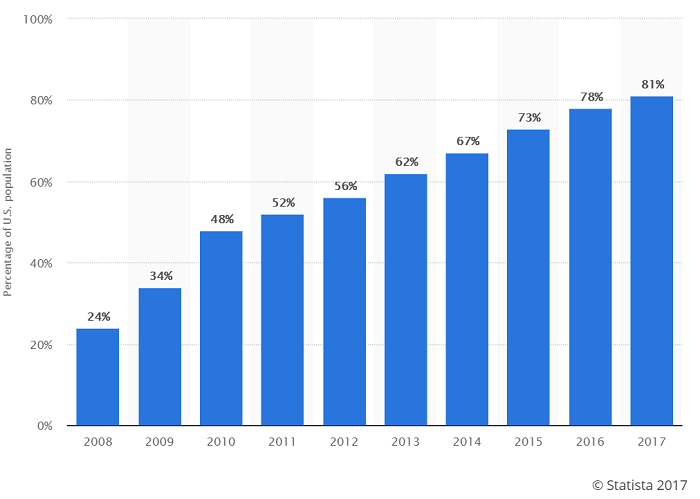
And this is expected to grow in the coming years.
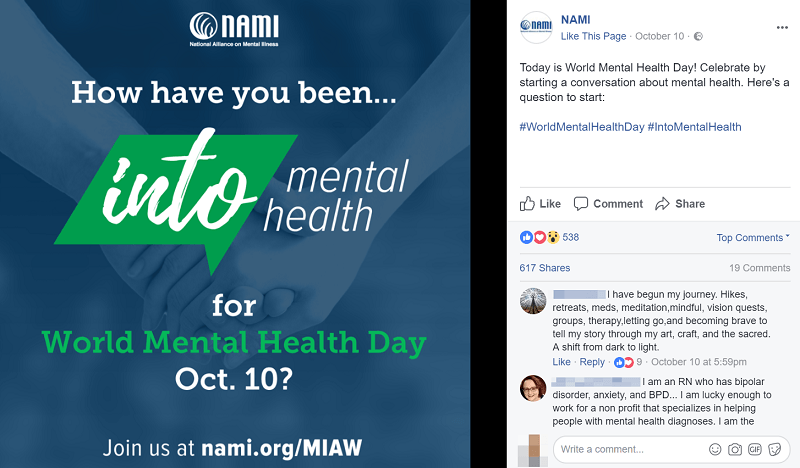
The National Alliance on Mental Illness (NAMI) organization has an active social media page.
They use the page to raise donations, awareness for mental illness and relevant event and spark a discussion among their fans.
Here’s one of their recent post on their Facebook page raising awareness for the World Mental Health Day.
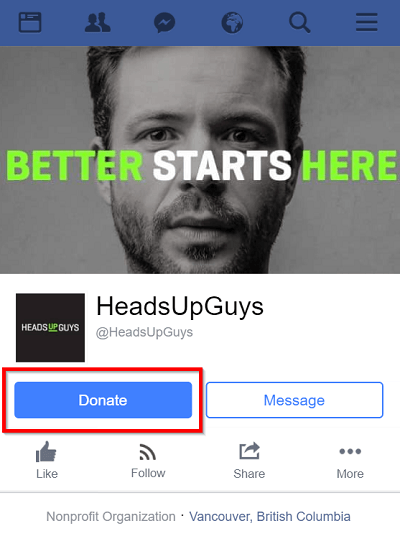
HeadUpGuys is another organization that is using Facebook to build a community for its cause. They have more than 18,000 followers on Facebook.
They even ask for donations on their Facebook page.
Community building is everything online.
If you can get people talking about your organization, they’ll do the marketing for you.
Get a responsive design for your nonprofit website
A website with a responsive web design is suitable for all screen sizes.
A good responsive web design will help visitors navigate your site no matter the kind of device they are using.
For example, the Live Strong, an organization that helps cancer patients has a website that adjusts itself to any screen size.
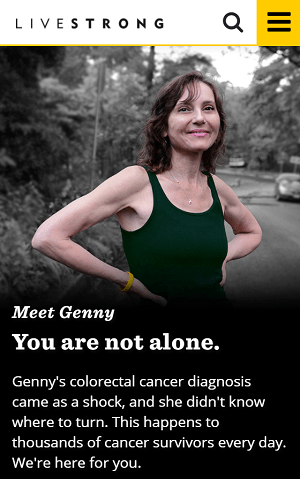
Make sure your organization’s website is usable across all types of devices.
Conclusion
You’ll help nonprofit organizations excel through digital marketing if you apply the tips reveal in this post.
Also, if you own or have a business, you can use it to help nonprofits.
For example, Elville and Associates, a special planning and elder law firm in Maryland raise money for charities through their business.
You can use your company to make the world a better place.
Please let’s help more nonprofits succeed.
Thank you for reading.
FAQ
What are some effective strategies for winning supporters and donors online?
Effective strategies for winning supporters and donors online include creating compelling storytelling content, engaging with your audience on social media, leveraging email marketing campaigns, providing multiple donation options, and showcasing the impact of donations through testimonials and success stories.
How can AI help nonprofits get more donors?
AI can help nonprofits draft donor emails, create social media content, repurpose impact stories, personalize supporter journeys, summarize campaign data, write FAQ content, and improve marketing workflows. Human review is still needed for accuracy, tone, and privacy.
What makes a nonprofit website trustworthy?
A trustworthy nonprofit website has a clear mission, secure donation page, updated impact stories, contact information, privacy policy, team or leadership details, transparent giving information, recent content, and clear next steps for donors and volunteers.
What online channels are best for nonprofit supporter growth?
The best online channels for nonprofit supporter growth usually include the website, email marketing, SEO, social media, video content, donation pages, campaign landing pages, partner referrals, and online events. The right mix depends on the audience and campaign goal.
How do nonprofits turn website visitors into donors?
Nonprofits can turn website visitors into donors by making the mission clear, showing impact, using strong calls to action, simplifying the donation process, offering recurring giving, answering donor questions, and following up with thank-you and impact emails.
How can storytelling be used to engage and win supporters and donors online?
Storytelling can be used to engage and win supporters and donors online by sharing personal anecdotes, highlighting the mission and impact of your organization, and creating emotional connections with your audience. Compelling narratives can inspire empathy and motivate individuals to support your cause.
What role does social media play in winning supporters and donors online?
Social media plays a crucial role in winning supporters and donors online by providing platforms to connect with a wider audience, share impactful content, cultivate relationships, and amplify your organization’s message. Engaging regularly with followers and leveraging social media advertising can help reach new potential donors.
How can email marketing campaigns be utilized to win supporters and donors online?
Email marketing campaigns can be utilized to win supporters and donors online by delivering personalized messages, sharing updates and success stories, and providing opportunities for direct engagement and donations. Segmenting email lists and crafting compelling subject lines can increase open rates and conversions.
What are some effective donation options to offer online supporters and donors?
Effective donation options to offer online supporters and donors include one-time donations, recurring donations, matching gift campaigns, crowdfunding campaigns, and peer-to-peer fundraising initiatives. Providing multiple donation channels and payment methods can cater to diverse donor preferences.
How can organizations showcase the impact of donations to win supporters and donors online?
Organizations can showcase the impact of donations to win supporters and donors online by sharing success stories, testimonials, and progress updates through blog posts, videos, and social media posts. Transparent reporting and accountability demonstrate how donations contribute to tangible outcomes and social impact.
What are some best practices for engaging with online supporters and donors?
Best practices for engaging with online supporters and donors include responding promptly to inquiries and feedback, expressing gratitude for contributions, providing regular updates on initiatives and progress, and offering opportunities for involvement and participation in fundraising events or campaigns.
How can organizations leverage online fundraising platforms to win supporters and donors?
Organizations can leverage online fundraising platforms to win supporters and donors by creating customized donation pages, leveraging peer-to-peer fundraising features, and utilizing built-in marketing and analytics tools. Integrating these platforms with social media and email marketing campaigns can amplify fundraising efforts.
What role do testimonials and success stories play in winning supporters and donors online?
Testimonials and success stories play a crucial role in winning supporters and donors online by providing social proof and building trust with potential donors. Real-life accounts of how donations have made a difference can inspire confidence and encourage others to contribute to your cause.
How can organizations measure the effectiveness of their online fundraising efforts in winning supporters and donors?
Organizations can measure the effectiveness of their online fundraising efforts in winning supporters and donors by tracking key performance indicators (KPIs) such as donation conversion rates, website traffic, email open and click-through rates, social media engagement metrics, and overall fundraising goals.
Related articles
- Travel Blog Title Examples
- Top Digital Marketing Audio Books
- Top Artificial Intelligence Books
- Top Christian Audio Books
- Church Fundraising Ideas
- AI Social Media Agents for Pest Control
- Animal Shelter Social Media Post Examples
- Free Social Media Post Generator for Nonprofits
- Nonprofit YouTube Title Examples
Check out our latest Content
Articles, Images, Videos, and more!
Get a Christian Coloring Book this Christmas
Never get Stuck – Ask the AI Buddy Anything
Convert Text into any Case
Pros and Cons of Shopping
Epic YT Title Examples
Earn $2000 a month!
Latest Videos