AI Marketing for Nonprofits: Use Cases, Tools and Best Practices
Discover why marketers are falling in love with AI Marketing Tools and start today for free.

AI marketing can sound like one of those buzzwords that gets tossed around until nobody knows what it means anymore.
For nonprofits, it is much simpler than that.
It means using AI tools to help your team write faster, repurpose content, personalize outreach, spot patterns in data, and spend less time drowning in repetitive marketing tasks. Not to replace your mission. Not to replace your staff. And definitely not to replace the human stories that move people to care.
That is where nonprofit teams have the most to gain.
Small teams are expected to do a lot with very little. You need to create emails, social posts, campaign pages, reports, donor updates, and event promotion without burning out your staff or watering down your message. AI can help lighten that load when you use it with clear goals, human review, and responsible guardrails.
In this guide, you will learn how AI marketing works for nonprofits, where it can save the most time, which use cases are worth trying first, and how to build a simple system that supports fundraising, awareness, and community engagement.
Chapters
AI Marketing Starter Kit
Future-Proof Your Strategy
What's your goal?
Find the right AI tool for your specific marketing need.
Better Inputs = Better Outputs
Don't settle for generic AI text. Use these structures.
The Blog Outliner
"Act as an SEO expert. Create a detailed outline for a blog post about [Topic] targeting [Audience]. Include H2s, H3s, and a bulleted list of key takeaways."
The Viral Hook
"Write 5 catchy, curiosity-driven hooks for a LinkedIn/Twitter post about [Topic]. Use a conversational tone and include emojis. Limit to 2 sentences per hook."
The Email Subject
"Generate 10 email subject lines for a newsletter about [Topic]. Make them urgent but not clickbaity. Max 50 characters."
Time Saved = Growth
See how many hours AI can give back to you.
Based on 5x speed increase with AI tools.
AI-Powered Content Creation Tools

AI Content Creation Tools are getting more powerful month-over-month and are helping marketers to create more and better content faster than ever before.
Sure, some people use AI Content Creation Tools to create sub-standard content, but the trick is to get AI to help you create variations so you can pick the best one and perfect that. More on that later in this guide. Let’s first look take a helicopter view on how AI Content Creation Tools help:
AI Content Creation Tools help to:
- Overcome writer’s block;
- Create variations so you can select and perfect the best one;
- Scale Content Production.

Overcome Writer’s Block With AI-Powered Content Creation Tools
AI Copywriting Assistants have been helping marketers overcome Writer’s Block even in the GPT3 age. If you’re stuck on your blog outline, your social media caption, or your ads, type a couple of keywords in an AI Copywriting assistant, and within seconds you’ll get the ball rolling.
Let’s say you’re starting a new blog post. Let’s say it’s about ‘How to start with AI Marketing’. Geezz. Blanck page. There we go… Start writing, please… Let’s make a new cup of coffee first. Ah, maybe open a window. Ok, let’s start writing.
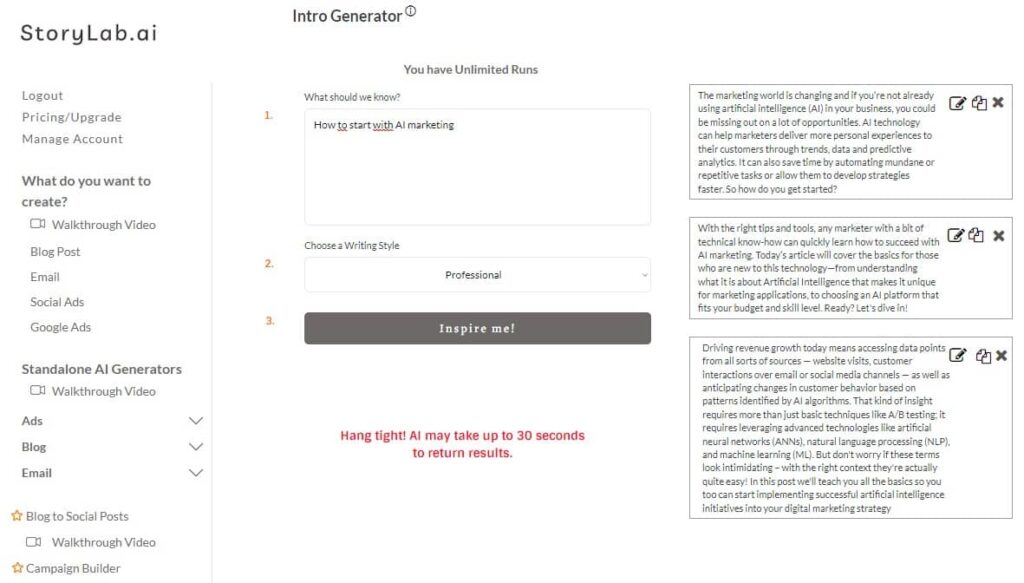
Or. Simply enter ‘How to start with AI Marketing’ in a Blog Intro Generator. Here’s what it looks like when we enter those keywords in StoryLab.ai’s Blog Intro Generator:

Blog Intro Generator Outputs:
- The marketing world is changing and if you’re not already using artificial intelligence (AI) in your business, you could be missing out on a lot of opportunities. AI technology can help marketers deliver more personal experiences to their customers through trends, data and predictive analytics. It can also save time by automating mundane or repetitive tasks or allow them to develop strategies faster. So how do you get started?
- With the right tips and tools, any marketer with a bit of technical know-how can quickly learn how to succeed with AI marketing. Today’s article will cover the basics for those who are new to this technology—from understanding what it is about Artificial Intelligence that makes it unique for marketing applications, to choosing an AI platform that fits your budget and skill level. Ready? Let’s dive in!
- Driving revenue growth today means accessing data points from all sorts of sources — website visits, customer interactions over email or social media channels — as well as anticipating changes in customer behavior based on patterns identified by AI algorithms. That kind of insight requires more than just basic techniques like A/B testing; it requires leveraging advanced technologies like artificial neural networks (ANNs), natural language processing (NLP), and machine learning (ML). But don’t worry if these terms look intimidating – with the right context they’re actually quite easy! In this post we’ll teach you all the basics so you too can start implementing successful artificial intelligence initiatives into your digital marketing strategy
If I’d like, I can re-run the AI Tool and get more inspirational pieces. Or, I can select one of the outputs and perfect it. Beats staring at a white screen, right?
As mentioned above. You can do this for your social media posts, articles, product descriptions, ads, YouTube titles or descriptions, you name it.
Here are a couple of cool AI Marketing Copy Generators you can try out:
Create variations with AI so you can select and perfect the best piece
One of the cool powers of AI is that it can help you come up with variations from different angles.
Regardless if you’re a seasoned copywriter or not a copywriter at all; producing good, sticky, punchy copy from a variety of angles can get pretty exhausting.
Think about your Google ads. How difficult it is to come up with 5 headline variations. What if you’re running dozens of Google ads? Would it not be awesome to get help from AI to come up with variations and you simply select the ones you love most and perfect those?
Creating variations and getting insights from different angles is not just great for ads. Also for your headlines, your social posts, your email subject lines, and even email body text. AI can do it. AI can help you brainstorm. 24/7. Whenever you need it.
And here’s the cool thing.
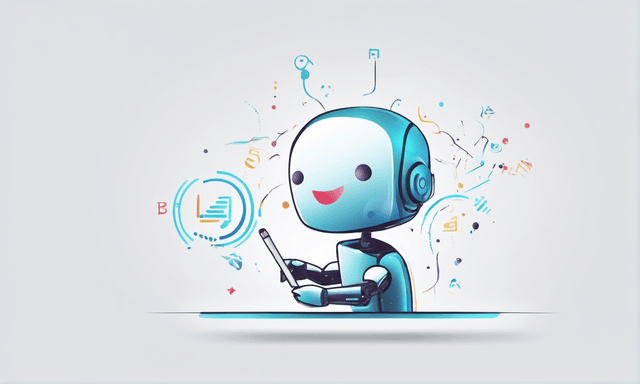
AI can not just help to come up with Marketing Copy Variations. Also Visuals!
You have no idea how many visuals we’ve generated for this blog post. At the end of the day, we’ve selected just a handful. The best ones 😉
Use one of the AI Marketing Copy Generators we shared above to create awesome copy variations and try one of the AI Tools below to create awesome visuals. Some AI Platforms (like StoryLab.ai, Writersonic, etc. offer both in one platform).
Scale Content Production with AI
Of course, the coolest thing (in my opinion) is the fact that AI can help you achieve your dreams much faster.
When I have a plan, it’s never; ‘I need to create this one piece of content’. It’s a much bigger plan / strategy and I need quite some pieces of content and it’s quite daunting just thinking about it.
For instance.
The guide you’re reading right now is just one small piece of the bigger strategy of helping people to become more effective with their marketing. AI is just a part of that yet again.
With the help of AI, I can achieve my dream a lot faster because creating a piece of content can be 10x faster. And the quality will be even better than if I would not use AI.
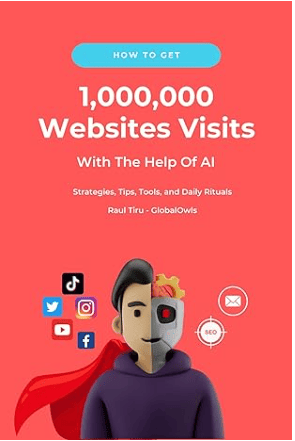
In my book ‘How to get 1,000,000 website traffic with the help of AI‘ I go over how AI can fit into your overarching Content and SEO Strategy. Be sure to check it out! Simply creating more content (even with the help of AI) will not mean you’ll achieve your goals if the pieces of content you’re creating do not fit into your SEO strategy.

When we talk about scaling content with the help of AI, we’re not simply talking about written articles. It’s also your YouTube videos and getting AI to help your write or refine your script. Create variations for your YouTube Titles, Write YouTube Descriptions faster than ever before so you can get back to creating your next video faster, and much more.
Next to your articles and video content, AI can also help with content distribution so you can get back to creating more content faster and so you can engage on Social Media instead of wasting time on creating social media captions and visuals. The opportunities are endless.

Achieve your Goals Faster with the Help of AI
There is a lot more we can discuss to help you achieve your goals faster with the help of AI. We’ll be sure to update this guide and consider joining our community. You can ask us anything and the moderators of the community are seasoned marketers and have not just played around with AI, they’ve also created AI Tools. Check out the community here.
Free AI Content Creation, Marketing & Growth Masterclass [Video]

One of our community moderators, Erwin Lima, recorded a free AI Content Creation Masterclass.
This free Masterclass is a 90-minute introduction to the world of AI copywriting and content creation, and how to think about, work with, and implement AI content tools into your marketing strategies, tactics, and processes to maximum effect.
Watch the Full AI Content Creation, Marketing, and Growth Masterclass for free:
AI Marketing Use Cases (What to Use AI for First)
If you’re new to AI marketing, start with these use cases. They give quick wins without a heavy tech setup.
| Use case | What AI does | Best starting point |
|---|---|---|
| Content ideation + drafting | Creates titles, outlines, intros, and variations | Blog + social drafts |
| Ad copy variations | Generates headline/description options for testing | Google + social ads |
| Email personalization | Writes subject lines and segment-specific angles | Welcome + nurture sequences |
| SEO support | Helps structure pages, FAQs, and internal links | Refresh top pages |
| Analytics summaries | Turns dashboards into plain-English insights | Weekly performance review |
| Personalization | Helps tailor content/offers to audiences | Homepage or landing page tests |
AI Marketing Strategy (A Simple Framework)
1) Pick one business goal
Examples: more qualified leads, higher conversion rate, lower CPA, better retention.
2) Choose one channel to improve first
Email, paid ads, SEO content, or social. One channel keeps the rollout manageable.
3) Add AI where it saves time or improves decisions
Drafting, variations, audience insights, reporting, and routine workflows are good starting points.
4) Create a “human + AI” workflow
AI generates options. A human selects, edits, adds proof, and approves.
5) Measure, learn, repeat
Run small tests weekly. Keep what works. Drop what does not.
90-Day AI Marketing Plan
| Timeline | What you do | Output |
|---|---|---|
| Days 1–30 | Pick 1 channel + set baseline KPIs. Build prompt templates. Create variations for 3 campaigns or 3 posts. | Repeatable workflow + first tests |
| Days 31–60 | Scale what worked. Add a content repurposing flow. Create a weekly reporting summary with AI. | More volume + consistent measurement |
| Days 61–90 | Improve targeting and personalization. Tighten brand voice guidelines. Document your process. | Smoother execution + better ROI signals |
Copy/Paste Prompt Templates
Content brief prompt
Create a content brief for: [topic] Audience: [who] Goal: [traffic/leads/sales] Primary keyword: [keyword] Include: [3 key points] Tone: [tone] Output: title ideas, outline (H2/H3), intro options, and 5 FAQs.
Ad variation prompt
Write ad copy variations for:
Offer: [offer]
Audience: [who]
Proof: [metric/review/differentiator]
Platform: [Google/Facebook/LinkedIn]
Give me 10 angles. Include CTA options. Keep it compliant and clear.
Email subject line prompt
Write 15 subject lines for:
Email topic: [topic]
Audience: [who]
Tone: [tone]
Avoid: spammy words
Give me 5 curiosity, 5 benefit, 5 short and direct.

What AI marketing means for nonprofits
AI marketing for nonprofits is the use of artificial intelligence to help plan, create, improve, and analyze marketing activities. That can include drafting emails, repurposing blog posts into social content, summarizing supporter feedback, testing ad copy, translating messages, or identifying patterns in donor and audience behavior.
For nonprofit teams, the biggest win is usually not flashy automation. It is getting more good work done with less friction.
Instead of staring at a blank page for an hour, your team can generate a first draft in minutes. Instead of rewriting the same campaign message for five channels, you can turn one strong idea into email copy, social captions, landing page text, video scripts, and volunteer recruitment posts faster. Instead of manually pulling insights from scattered notes, AI can help summarize what supporters are asking, what messages are landing, and where your content is losing momentum.
The key is to treat AI like an assistant, not an autopilot. Your team still needs to guide the strategy, check facts, protect sensitive information, and bring real empathy to the final message.
Best nonprofit AI marketing use cases to start with
If your nonprofit is just getting started, do not try to rebuild your whole marketing department in one week. Start with the tasks that eat time and slow down momentum.
Content creation is usually the easiest place to begin. AI can help you draft blog outlines, improve headlines, turn reports into readable articles, and create multiple versions of the same message for different channels.
Email marketing is another strong starting point. Nonprofits can use AI to draft welcome emails, donation follow-ups, event reminders, monthly updates, and volunteer outreach. This helps small teams stay consistent without sounding like robots, as long as someone reviews and refines the final message.
Social media is also a natural fit. AI can help brainstorm campaign angles, rewrite posts for each platform, suggest content batches, and revive older posts that still matter.
After that, teams can move into more advanced use cases such as supporter segmentation, donor engagement insights, chatbot support, survey analysis, and marketing reporting summaries.
A good rule is simple: start where the work is repetitive, time-heavy, and still important enough to deserve improvement.
How nonprofits can build an AI marketing workflow that actually helps
A lot of teams get stuck because they think they need the perfect AI stack before they can begin. They do not.
A useful nonprofit AI marketing workflow can start with four steps.
First, choose one goal. That might be increasing donations from email, improving volunteer sign-ups, publishing more educational content, or keeping social channels active without scrambling every day.
Second, choose one workflow. Pick something concrete, like turning one blog post into five social posts and one email, or turning campaign notes into a donation page draft and three ad copy variations.
Third, create a simple human review process. Decide who checks brand voice, facts, links, and tone before anything goes live. This matters because AI can sound polished while still getting details wrong.
Fourth, track whether the workflow actually helps. Did your team save time? Publish more consistently? Improve click-through rates? Raise more money? Get more event registrations? If the answer is yes, keep going. If not, tweak the process instead of piling on more tools.
That is how AI becomes useful instead of becoming one more tab open in your browser.
AI marketing tools nonprofits can actually use
Nonprofit teams do not always need a giant enterprise platform to get value from AI. In many cases, a practical mix of general tools and nonprofit-friendly platforms works better.
For writing and ideation, teams often start with tools that help with brainstorming, drafting, and rewriting. These can support blog creation, donor emails, campaign messaging, and content repurposing.
For design and social, AI-powered content tools can help create graphics, caption variations, and platform-specific copy faster.
For CRM and outreach, some nonprofit-focused platforms now bring AI into donor engagement, prioritization, and personalization workflows.
For internal operations, AI can help summarize meetings, organize research, translate content, or create first drafts of reports and campaign recaps.
The smartest move is not to chase the biggest tool list. It is to choose a few tools that reduce busywork, fit your team’s skill level, and respect your organization’s privacy and review needs.
Responsible AI marketing for nonprofits
This part deserves its own section because it is where a lot of weak AI content falls apart.
Nonprofits cannot afford sloppy use of AI.
Your organization may handle sensitive stories, donor information, community data, and mission-driven messaging that affects real people. That means AI should never be used carelessly. Staff need clear rules for what can be shared with tools, how outputs are reviewed, and when human judgment must override automation.
Responsible AI marketing starts with a few practical habits.
Do not paste sensitive data into tools without checking privacy settings and internal policy first. Review facts before publishing. Watch for biased wording, weak assumptions, or generic language that flattens real human experiences. Be careful with emotional storytelling, especially when communities are already vulnerable or misrepresented.
The goal is not to avoid AI entirely. It is to use it in a way that supports trust.
For nonprofits, trust is not a nice extra. It is the whole game.
How to measure whether AI marketing is working
AI marketing should not be judged by how impressed your team is with the output on day one.
It should be judged by whether it improves your work.
Start by measuring time saved. If AI helps your team produce a campaign draft in 30 minutes instead of two hours, that matters.
Then look at performance metrics tied to your actual goal. For content marketing, that might be organic traffic, engaged time, email sign-ups, or downloads. For fundraising, it could be donation conversions, donor retention signals, click-through rates, or response rates. For volunteer marketing, it may be event registrations, form completions, or application starts.
Also track quality. Are your messages clearer? Are campaigns going out more consistently? Is your team spending more time on creative thinking and relationship-building instead of repetitive production work?
Good AI marketing is not about publishing more for the sake of it. It is about helping a nonprofit create stronger work with the resources it already has.
FAQ
What is AI marketing for nonprofits?
AI marketing for nonprofits means using artificial intelligence to help with tasks like content creation, email drafting, supporter segmentation, social media planning, reporting, and campaign optimization. The strongest use cases save staff time while still keeping people in control of the final message.
How can nonprofits use AI in marketing without losing their human voice?
Nonprofits can use AI for first drafts, brainstorming, repurposing, and summaries, then rely on human review for tone, accuracy, empathy, and mission alignment. That human-first approach is recommended across nonprofit AI guidance because relationships and trust still drive results.
What are the best AI marketing use cases for small nonprofit teams?
The best starting points are usually content repurposing, email drafting, social media planning, campaign copy variations, and summarizing audience feedback. These are practical, lower-risk tasks that help small teams produce more consistent marketing without major technical complexity.
Do nonprofits need an AI policy before using AI marketing tools?
It is a smart move. A responsible AI policy helps staff understand what data should never be shared, how outputs should be reviewed, and where human oversight is required. That is especially important for nonprofits handling sensitive stories, donor information, or community data.
Can AI help nonprofits with fundraising marketing?
Yes. AI can support fundraising marketing by helping teams draft donor emails, personalize outreach, analyze supporter patterns, summarize campaign results, and improve content production speed. It works best when paired with clear goals and human review rather than full automation.
What AI tools are useful for nonprofit marketing teams?
Useful options include general-purpose writing and brainstorming tools, AI-powered design and social tools, and nonprofit-specific platforms that support donor engagement and fundraising workflows. The right choice depends on whether your biggest bottleneck is content, reporting, design, outreach, or segmentation.
How should nonprofits measure AI marketing success?
Start with time saved and output consistency, then track real campaign metrics such as email clicks, donations, volunteer sign-ups, conversions, or engagement. AI marketing is only valuable if it improves results or frees up time for higher-value work.
Is AI marketing safe for nonprofits?
It can be, but only when nonprofits use clear safeguards. Teams should avoid sharing sensitive information carelessly, review outputs for bias and errors, and put human judgment above automation in public-facing messaging. Responsible use is a repeated theme in nonprofit AI guidance.
What is AI marketing?
AI marketing is using AI to improve marketing planning, execution, personalization, and measurement based on data and feedback.
What should I use AI for first?
Start with drafting content, generating variations for ads and emails, and summarizing performance reports.
Will AI replace marketers?
AI speeds up tasks and improves decision-making, but humans still own strategy, positioning, and final judgment.
Is AI marketing only for big companies?
No. Small teams often benefit most because AI helps them move faster with fewer people.
What are the risks?
Brand voice drift, inaccurate claims, privacy issues, and over-automation. Use human review and clear guidelines.