How to Write with Fewer Mistakes in 2024 [Tips and Tools]
Want to learn to write with fewer mistakes? See how the Grammarly tool can help you write content like a pro.
If you’ve ever used Grammarly before you know how helpful it is. You also know how irritating the mistake alerts can be. You spend hours on writing and rewording the text you think is great, and then Grammarly greets you with this.

If you got tired by this already, here’s what you should focus on to reduce this number to the minimum.
Set goals
First off, make sure you set the goals correctly. If you’re writing a blog post for your NGO website, here’s what you should probably check in the assistant.
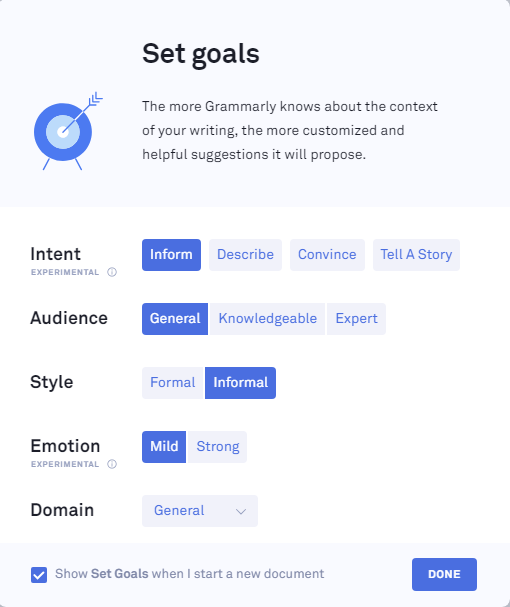
Adjust the goals to the type of text you’re writing, but if you want to reach the biggest audience, this is the basic setting you should follow.
Misspelled words
Misspelled words are one of the biggest reasons your Grammarly assistant fires up with red. It’s obvious, and you do know how to spell words properly. The thing is, if you spend a considerable part of your day writing, or write in a rush, you misspell words all the time.
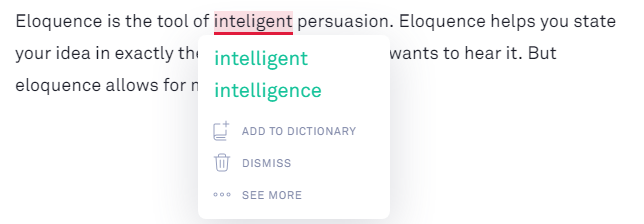
This is why double checking the spelling is always a good idea.
Some words may be marked as misspelled because of regional variety. Grammarly doesn’t always pick on them, and it’s not a big deal if it does highlight them.
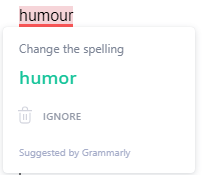
Note, that sometimes Grammarly makes mistakes too.
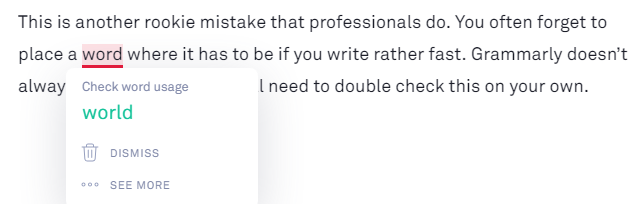
Missing words
This is another rookie mistake that professionals do. You often forget to place a word where it has to be if you write rather fast. Grammarly doesn’t always detect this so you will need to double check this on your own.
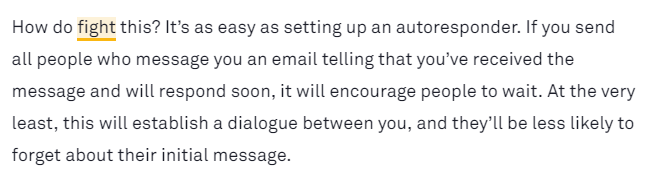
The words that get left out the most are the pronouns and auxiliary words.
Incorrect comma placement
Commas can be tricky to grasp. Especially so if you’re writing fast and put a comma after every conjunction, or don’t put commas at all.
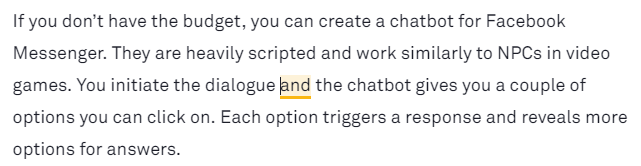
The most common mistakes when it comes to punctuation are:
- Missing comma in a compound predicate
- Missing comma between coordinate adjectives
- Missing comma between independent clauses
- Comma between dependent clauses
- Comma splice
Punctuation is too big of a topic for this post alone. In a nutshell, place a comma between items of a list and place a comma between coordinate clauses. Don’t place a comma between subordinate clauses and in the place where a full stop would suit better. This will help you with the majority of mistakes.
For in-depth knowledge, check out Grammarly’s post on commas.
Repetition
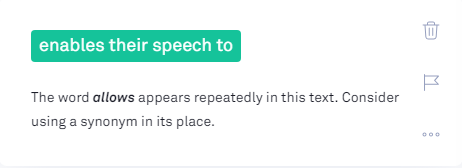
If a word is overused in the article or repeated in the same paragraph, it will be highlighted by Grammarly Pro. Here’s the sentence about eloquence you saw earlier with the assistant on.

Grammarly highlights it because the word “eloquence” appears too often here, and offers you substitutes.
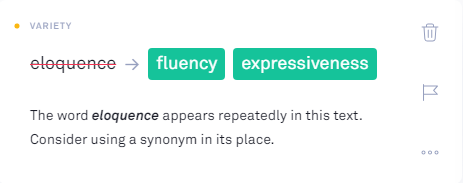
This is very handy, as often you may not pay attention to one word, and keep abusing it. This can happen if you’re writing on a specific theme and you have to go out of your way to come up with synonyms.
However, as is with the case of “eloquence,” Grammarly’s advice can be redundant. It’s a basic rule of three, and there’s nothing bad with repeating some words for dramatic effect.
Overused words
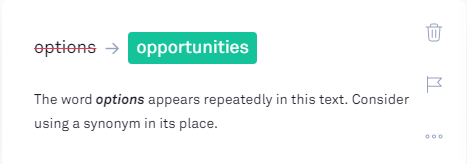
If you want to keep the number of highlighted mistakes down to the minimum, you have to forget about overused words. Grammarly forces you to break conventions and think outside of the box when it comes to wording.
However, don’t treat Grammarly as a machine that knows better than you. For the most part, you can go with the overused word if it’s not overused in your article.
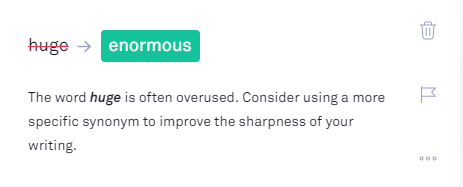
In this case, if you don’t have the word “huge” appear ten times in your text, you can skip this tip.
Other tips like this are more useful.
Vague words
If you want to make your NGO content perfect for Grammarly, you have to be sure your readers understand you. Grammarly doesn’t just check spelling and punctuation, it tries to help your customers understand your content.
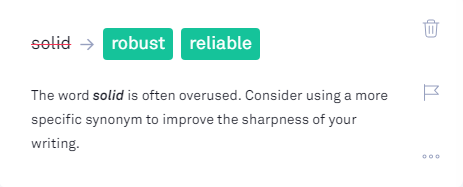
If you have a word that has many meanings, you may want to stick to a more precise synonym. This is especially critical if it can be understood both ways in the context.
Unnecessary phrases
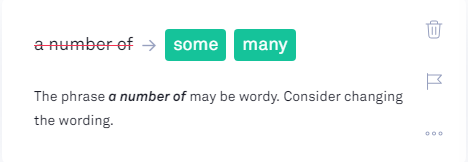
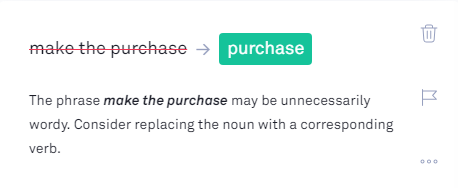
Keeping your content fit for Grammarly means being brief but meaningful. No reader wants to read three words when they can read one without the loss of meaning.
Cut down on the wordiness, and Grammarly will rank your content higher.
Passive voice
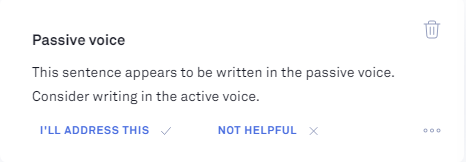
One of the most important lessons William Strunk gives in the Elements of Style is this: “Use the active voice. The active voice is usually more direct and vigorous than the passive.”
The book is almost a century old, but the advice is as relevant as ever. Avoid using the passive voice, and you’ll get far less yellow highlights in Grammarly.
If you are using HR software for your writers, this is the point you should include in the guidelines for them.
Your readers will appreciate this because it’s hard to tell a compelling story with a lot of passive voice constructions.
Unclear antecedent
It’s a common mistake that is easy to make even for a professional. When you write about something, you keep all the information you write about in mind. It’s easy to slip and write “this” or “they” because you know what it refers to.
Once you reread the text, the connection becomes unclear.

In this case, it was unclear what “this” refers to, and the paragraph before this one needed some changes to clarify that.
Sentence fragment
A sentence fragment is a group of words that looks like a sentence but isn’t one. Here’s an example.
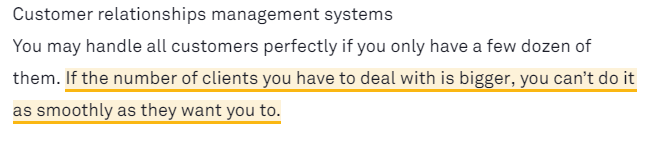
On this own, this sentence wouldn’t make any sense. It only makes sense in the context. Avoid these, or at least provide sufficient context for them.
Monotony
Monotony rarely pops up in your Grammarly mistakes, but it hurts the reading process rather badly. A group of sentences with a similar length and structure will be highlighted as monotonous.
Avoid this mistake by alternating sentence lengths at least every two sentences. This makes reading a lot easier.
Readability
If you click on the performance button, you will get a lot of statistics about your text. One of them is the readability score.
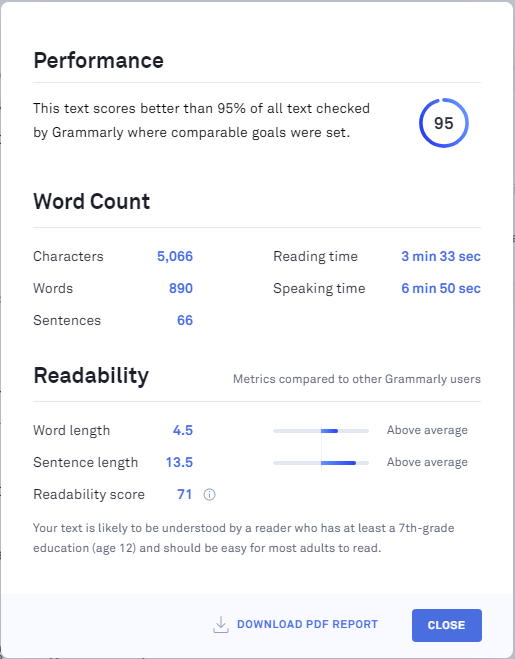
If the score is too above average, you will be missing a chunk of your audience. Make sure you don’t overuse long words and sentences as well as overly complicated words if you’re making content for the average people.
You can’t be perfect
Grammarly isn’t a perfect tool. It constantly highlights something that doesn’t need fixing. You aren’t a perfect writer. You will misspell words, miss commas, and create unclear sentences.
It’s okay though. You two make a perfect team to create perfect texts.
FAQ
What Are Some Common Writing Mistakes to Look Out For?
Common mistakes include grammatical errors, punctuation errors, spelling mistakes, incorrect word usage, and sentence structure issues.
How Can Reading Out Loud Help in Reducing Writing Mistakes?
Reading your text out loud can help catch errors that you might miss when reading silently, as it forces you to slow down and can make awkward or incorrect phrases more apparent.
What Role Does Proofreading Play in Writing With Fewer Mistakes?
Proofreading is crucial for catching and correcting errors, ensuring clarity, and improving the overall quality of your writing.
Can Grammar Checking Tools Help in Writing Error-Free Content?
Yes, grammar checking tools like Grammarly or Microsoft Word’s spell checker can help identify and correct many common mistakes in writing.
How Important is It to Understand Basic Grammar and Punctuation Rules?
A solid understanding of basic grammar and punctuation rules is essential for writing accurately and clearly, and for avoiding common mistakes.
What Are the Benefits of Taking Breaks Between Writing and Proofreading?
Taking breaks between writing and proofreading can help clear your mind, allowing you to return to your work with fresh eyes and a new perspective, making it easier to spot errors.
How Can Reading Widely Improve Writing Skills and Reduce Mistakes?
Reading a variety of texts can expose you to different writing styles, improve your vocabulary, and help you internalize correct grammar and punctuation usage.
Is It Helpful to Have Someone Else Review Your Writing?
Yes, having another person review your writing can be very helpful, as they can catch mistakes you might have overlooked and offer valuable feedback on how to improve your writing.
How Can Practicing Writing Regularly Help Reduce Mistakes?
Regular writing practice can improve your writing skills over time, helping you become more familiar with common rules and patterns, and reducing the likelihood of making mistakes.
What Strategies Can Be Used to Expand Vocabulary and Avoid Repetitive Mistakes?
Strategies to expand vocabulary include reading diverse materials, using a thesaurus, and learning new words daily. To avoid repetitive mistakes, take note of your common errors and consciously work on them.
How Can Setting Specific Writing Goals Help in Reducing Mistakes?
Setting goals, such as focusing on clear sentence structure or correct comma usage, can help you pay closer attention to specific aspects of writing, leading to fewer mistakes.
What is the Importance of Understanding the Audience in Writing Accurately?
Understanding your audience helps tailor your writing style and language, reducing the risk of miscommunication and errors relevant to your audience’s expectations.
How Can Developing a Writing Routine Improve Writing Accuracy?
A consistent writing routine can enhance your writing skills and attention to detail, making you more adept at identifying and avoiding mistakes.
What Role Does Active Reading Play in Enhancing Writing Skills?
Active reading, or reading with an analytical mindset, helps you learn from other writers, understand different writing techniques, and apply these learnings to your own writing.
How Effective are Writing Workshops or Courses in Reducing Writing Mistakes?
Writing workshops or courses can provide structured learning, professional feedback, and exposure to best practices, all of which can significantly reduce writing mistakes.
Can Keeping a Personal Error Log Help in Writing with Fewer Mistakes?
Maintaining a personal error log where you note and reflect on your recurring mistakes can help you become more aware of and work on these specific areas.
What is the Benefit of Simplifying Sentence Structure in Writing?
Simplifying sentence structure can make your writing clearer and more concise, reducing the likelihood of complex grammar errors and improving readability.
How Does Regularly Reviewing Grammar Rules Help in Writing?
Regularly reviewing grammar rules helps keep this knowledge fresh, enabling you to apply these rules more accurately in your writing.
Can Participating in Writing Forums or Groups Improve Writing Accuracy?
Participating in writing forums or groups allows you to receive feedback, learn from others’ mistakes, and stay informed about common writing pitfalls and how to avoid them.
What is the Impact of Writing in a Distraction-Free Environment on Writing Quality?
Writing in a distraction-free environment allows you to focus better, leading to more thoughtful writing and a reduced likelihood of making careless mistakes.
How Can Revisiting Past Work Improve Future Writing Accuracy?
Analyzing your past work helps identify patterns in mistakes, allowing you to consciously avoid them in future writing.
What is the Importance of Consistent Practice in Writing?
Consistent practice enhances familiarity with writing conventions and styles, gradually reducing the frequency of errors.
How Can Mind Mapping Assist in Organizing Thoughts and Reducing Errors?
Mind mapping before writing helps organize thoughts coherently, reducing structural and logical errors in the writing process.
What Role Does Patience Play in Writing With Fewer Mistakes?
Approaching writing with patience allows for thorough proofreading and thoughtful expression, which can significantly reduce errors.
How Can Writers Use Feedback to Minimize Mistakes?
Constructive feedback highlights areas for improvement and specific mistakes, guiding writers on where to focus their attention.
Can Limiting the Use of Jargon and Complex Language Reduce Writing Errors?
Using simple language and avoiding unnecessary jargon can make writing clearer and reduce the chance of errors.
How Does Building a Strong Vocabulary Influence Writing Accuracy?
A strong vocabulary allows for precise word choice, reducing errors related to incorrect terms or vague expressions.
What is the Benefit of Using Writing Templates or Structures?
Templates or structured formats provide a guide, reducing errors in organization and flow of writing.
How Does Developing a Clear Thesis or Main Idea Help in Writing Accurately?
A clear thesis or main idea provides a focused direction for writing, reducing irrelevant content and structural errors.
Can Time Management Techniques Improve Writing Quality?
Effective time management allows for dedicated writing and proofreading time, reducing rushed errors and improving overall writing quality.
Improve your Marketing with the Power of AI
See how you can start with AI Marketing and reach your goals faster than ever before. Check out the Tips, Strategies, AI Tools, Masterclass, Courses, and Community. Unleash the true potential of your brand with the help of AI.