How to Write a Video Script [Tips & AI Video Script Generator]
After you came up with your video idea, but before creating your video, you want to write your video script.
Just like your Video Marketing Strategy, you can make your video script as simple or complex as you want it to be.
In this post, we’ll go over a simple, yet effective way of writing your video script and we’re going to show how an AI Video Script Generator can help you brainstorm ideas.
Let’s get into it!
Related resources:
Chapters
1. Understand your Audience’s needs when writing your Video Script

As we mentioned in the Video Marketing Strategy Guide, understanding your audience’s needs and your unique value proposition is key to any video marketing success.
When writing your video script, you need to constantly search for what really is important for your audience, what their main problems are, and how you can help solve those problems.
Secondly, make the problem and solution as small and comprehensible as you can.
In our video marketing series, we also try and break problems and solutions down into manageable articles and videos.
Sure, you can do masterclasses and courses. But for the bulk of your videos, you should probably focus on one main problem and solution and write your video script around that.
2. Decide on the platform and Length before Writing your Video Script

People consume different types of videos on different platforms for different reasons. Your video script is going to differ based on if your video is going to be a YouTube Short, a Long-form YouTube video, a 2-minute TikTok video, or a 10-minute TikTok video.
In step 1 of your script writing process, you should have decided which problem / solution you want to discuss in your video.
Now, it’s time to decide which length and platform is best for bringing your message across.
3. Use the Simple Video Script Template
Now let’s get into the actual video script writing.
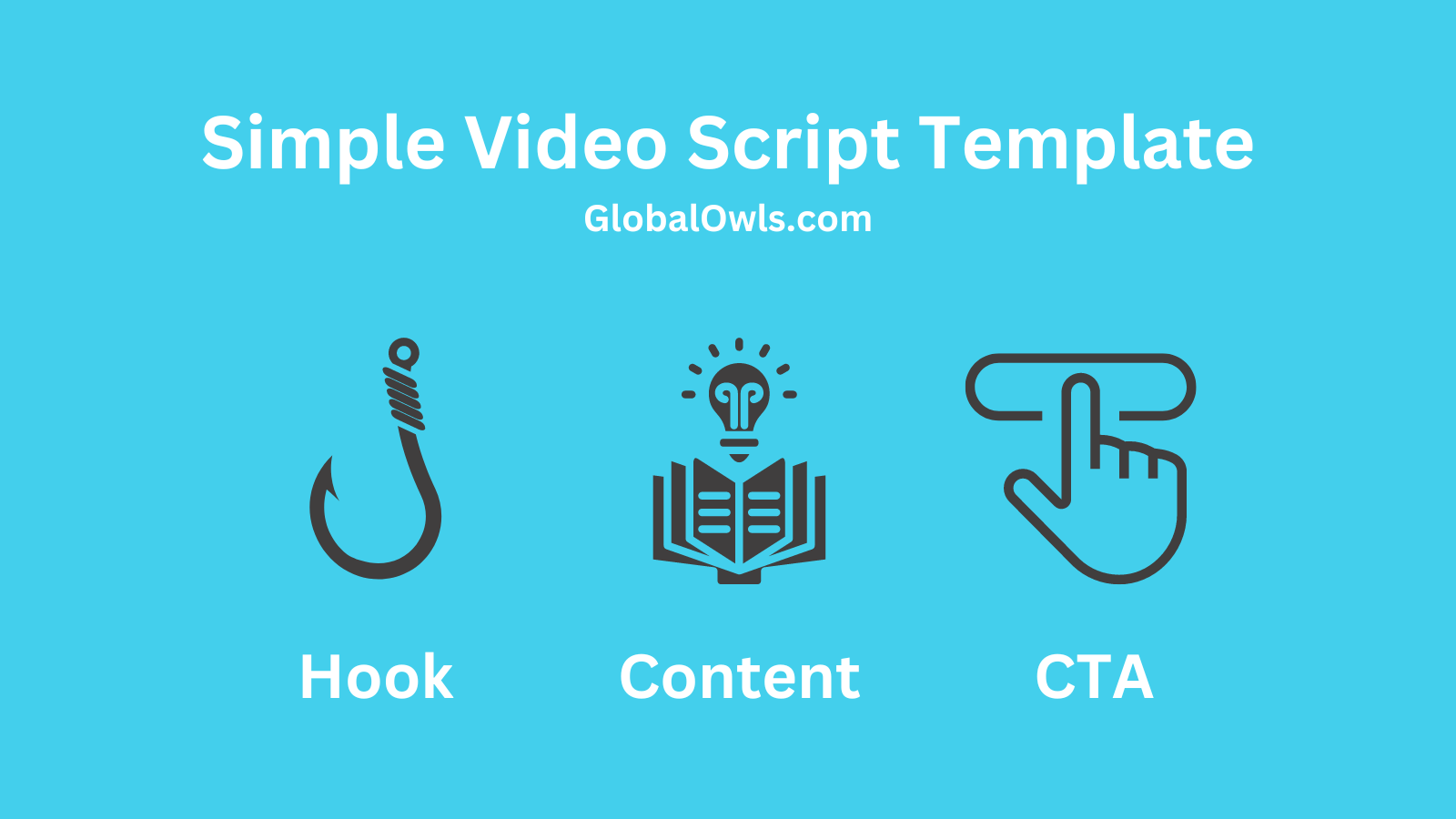
Again, you can make your video script as simple or complicated as you want. Here’s what a simple video script looks like:
Write your Hook in your Video Script
Your Video Hook helps you grab people’s attention so they understand the value of your video in the first few seconds and makes them want to watch your video if the topic is of interest to them.
There are various ways of structuring your Video Hook, but the most important thing is to stop people from scrolling (if on social media) and to get people excited to watch the entire video.
Here are a couple of examples of Video Hooks you could use for your Video Script:
Video Hook Examples
Intriguing Question: “Have you ever wondered what it takes to disappear completely and start a new life?” Start with a question that piques curiosity and promises an answer.
Startling Statistic: “Did you know that 90% of startups fail within the first year? Let’s dive into why and how you can beat the odds.” Use a surprising statistic to grab attention and segue into your video’s value.
Personal Anecdote: “I was inches away from giving up on my dream, and then something extraordinary happened.” Share a personal story that resonates emotionally and invites viewers to learn more.
Bold Statement: “We’ve been lied to about what truly makes a diet successful.” Make a bold or controversial statement that challenges common beliefs and encourages viewers to watch for an explanation.
Visual Shock: Start with a powerful, unexpected visual that leaves viewers eager to understand the context.
Promise of a Secret: “I’m going to share a marketing secret that doubled our sales in just one month.” Offer to reveal insider knowledge or a closely guarded secret.
Direct Challenge: “I bet you can’t do this simple exercise correctly.” Challenge the viewer directly, creating a scenario where they stay to prove you wrong or to test themselves.
Humorous Scenario: Begin with a funny misunderstanding or situation related to your topic, making viewers laugh and want to keep watching for more entertainment and value.
Historical Mystery or Fact: “A mystery from the 1800s that baffled scientists for centuries was finally solved. Here’s how.” Use a captivating historical fact or mystery as a springboard into your topic.
Immediate Action: Start in the middle of an action or process, like “Let’s dive right in—today, we’re hacking the personal finance system.” This pulls viewers into the midst of an engaging activity or story.
Write your Main Content in your Video Script
In the next section, you’re going to answer the main problem and give a solution. This is the meat and potato of your video, but don’t make it longer than it needs to be.
It’s fine to tell a story, but don’t go on tedium about all kinds of topics that might be important but deserve a video of their own.
Bonus
Somewhere in the middle of your video, you can add a second hook to keep people excited to watch the entire video or you can ask people to like, comment, or subscribe to your channel.
Don’t overdo it, but it might be nice to break down your video.
Write your CTA in your Video Script
At the end of the video, let people know how they can take action. Either to solve their problem with your tips, your products/services, or maybe you want to suggest a next video to watch to keep people engaged and learn more about what you have to offer.
4. Using an AI Video Script Generator

AI can help you spark creativity by coming up with cool ideas from multiple angles. Let’s see how an AI Video Script Generator can help us come up with cool scripts so we can select the best one for our video.
It will only take a couple of minutes and it can greatly improve the creativity and quality of the video script.
For this example, we choose the following:
- Length: 2 minutes
- Input (prompt): how to write a video script
- Tone: Storytelling
You can change the settings and run the AI Video Idea Generator as often as you need to get the creativity for writing the perfect video script.
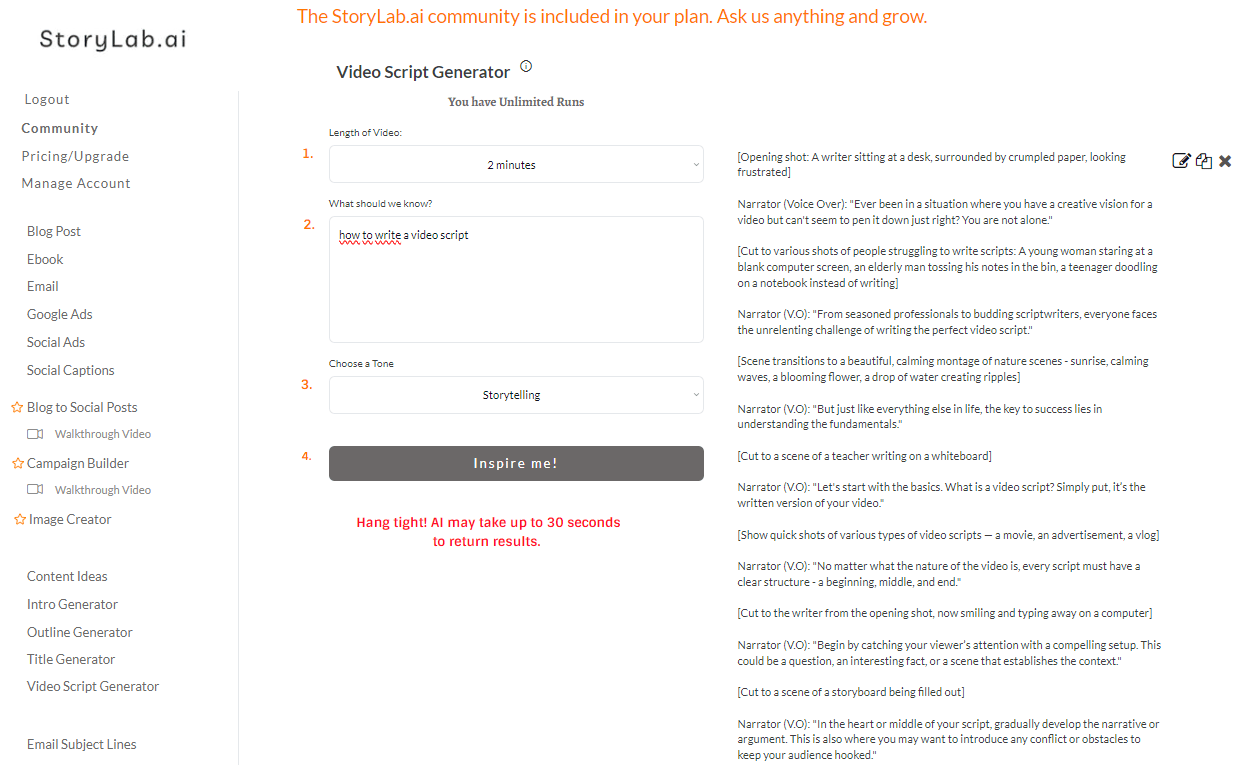
AI Video Script Generator Example Output:
[Opening shot: A writer sitting at a desk, surrounded by crumpled paper, looking frustrated]
Narrator (Voice Over): “Ever been in a situation where you have a creative vision for a video but can’t seem to pen it down just right? You are not alone.”
[Cut to various shots of people struggling to write scripts: A young woman staring at a blank computer screen, an elderly man tossing his notes in the bin, a teenager doodling on a notebook instead of writing]
Narrator (V.O): “From seasoned professionals to budding scriptwriters, everyone faces the unrelenting challenge of writing the perfect video script.”
[Scene transitions to a beautiful, calming montage of nature scenes – sunrise, calming waves, a blooming flower, a drop of water creating ripples]
Narrator (V.O): “But just like everything else in life, the key to success lies in understanding the fundamentals.”
[Cut to a scene of a teacher writing on a whiteboard]
Narrator (V.O): “Let’s start with the basics. What is a video script? Simply put, it’s the written version of your video.”
[Show quick shots of various types of video scripts — a movie, an advertisement, a vlog]
Narrator (V.O): “No matter what the nature of the video is, every script must have a clear structure – a beginning, middle, and end.”
[Cut to the writer from the opening shot, now smiling and typing away on a computer]
Narrator (V.O): “Begin by catching your viewer’s attention with a compelling setup. This could be a question, an interesting fact, or a scene that establishes the context.”
[Cut to a scene of a storyboard being filled out]
Narrator (V.O): “In the heart or middle of your script, gradually develop the narrative or argument. This is also where you may want to introduce any conflict or obstacles to keep your audience hooked.”
[Cut to a scene of a movie director yelling “CUT!”]
Narrator (V.O): “Finally, end with a satisfying resolution. Whether it’s a plot twist, a solution to a problem, or a poignant message, make sure it resonates with your audience.”
[Final shot: The writer from the opening scene, now looking satisfied, leans back in his chair, taking a deep breath]
Narrator (V.O): “Remember, a good script is a balance of information and emotion. So, let your creativity flow and start crafting that stellar video script.”
[The screen fades to black, with the text appearing: “Everyone has a story to tell. What’s yours?”]
Narrator (V.O): “Keep practicing, stay patient, and most importantly, enjoy the process. Everyone has a story to tell. Now, it’s time to share yours.”
[End of video]
Conclusion
There you have it. A step-by-step guide on how to write effective video scripts. Use our template and the AI Video Script Generator and write better video scripts faster than ever before. Your audience is going to love it.
GlobalOwls Empowers you to become the best version of yourself
Check out the following resources and Grow!