AI From Beats to Bytes: Exploring AI’s Impact on Video Streaming
In the ever-evolving technology landscape, Artificial Intelligence has proven to be a transformative force across various industries. One domain where its impact is increasingly evident is video streaming.
From enhancing user experiences to optimizing content delivery, AI has seamlessly transitioned from orchestrating beats to manipulating bytes.
In this blog, we’ll delve into the multifaceted influence of AI on video streaming, exploring its implications for both content providers and consumers.
Chapters
Why is AI Important for the Media and Entertainment Industry

AI holds significant importance in the media and entertainment industry because it revolutionizes content creation, distribution, and consumption. Here are several reasons why AI is crucial in the media and entertainment sector:
Content Creation and Enhancement
Artificial intelligence technologies like computer vision and deep learning can automate and enhance content creation. This includes video editing, image processing, and even generating entirely new content. AI can contribute to the development of visually stunning and innovative media.
Personalized Content Recommendations
AI algorithms analyze user preferences, viewing history, and behavior to recommend personalized content. This enhances user engagement, satisfaction, and the likelihood of content consumption, leading to increased viewer retention.
Content Discovery
AI-driven content discovery platforms help users find relevant and interesting content based on their preferences. This improves user experience and helps content creators and distributors reach their target audiences more effectively.
Dynamic Ad Insertion
AI enables dynamic and targeted ad insertion based on user profiles and preferences. This results in more relevant advertising, potentially increasing ad revenue for media companies and advertisers alike.
Automated Content Moderation

AI is crucial in automating content moderation processes, helping media companies filter out inappropriate or prohibited content quickly and efficiently. This is particularly important for maintaining a safe and compliant content environment.
Predictive Analytics
AI-driven predictive analytics help media companies forecast audience behavior, content trends, and market demands. This valuable information assists in making informed decisions regarding content creation, marketing strategies, and overall business planning.
Efficient Production Workflows
Artificial intelligence can streamline and optimize various aspects of production workflows, from scriptwriting to post-production. Automated processes like video editing can save time and resources, allowing for faster content creation and delivery.
Enhanced User Engagement
AI-driven chatbots and virtual assistants engage with users in real-time, providing personalized recommendations, answering queries, and improving the overall experience. This can lead to extraordinary levels of user satisfaction as well as loyalty.
Audience Insights and Targeting
AI analytics tools analyze audience behavior and preferences, providing media companies valuable insights into their target demographics. This information helps in creating more targeted and high-quality content and marketing campaigns.
Real-time Data Processing
AI enables real-time data processing and analysis, allowing media companies to respond swiftly to trends, user feedback, and market changes. This agility is crucial in a fast-paced industry where staying ahead is essential.
Monetization Opportunities
AI can identify new monetization opportunities by analyzing user data and market trends. This includes personalized pricing models, subscription plans, and targeted promotions to maximize revenue streams.
How Does Artificial Intelligence Affect the Video Streaming Industry?
A Grand View Research shows that the global AI in the media and entertainment market was around 14.81 billion in 2022. The number is projected to grow at 26% CAGR between 2023 and 2030. The demand for Generative AI in the entertainment and media market has grown and will reach around 412.7 million by 2023.
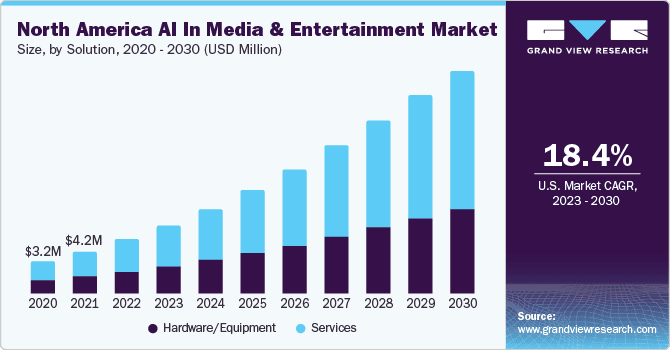
AI use in plagiarism detection, gameplay, fake story recognition, production planning & management, sales and marketing, talent finding, personalization, and other fields is propelling the growth of global AI in the media & entertainment sector. The growing popularity of virtual creation and its ability to create real-time virtual worlds and high-definition graphics are primary aspects of market growth.
Artificial Intelligence has also significantly impacted the video streaming industry, enhancing user experience, content delivery, and operational efficiency. Here are some key ways AI is influencing the video streaming sector:
Content Recommendation and Personalization
AI’s ability to analyze vast datasets is a game-changer in the media and entertainment industry. Statista reports that in 2022, the global market for this technology in the media and entertainment industry is projected to reach $2.3 billion.
A significant portion of this investment goes into refining content recommendation algorithms. AI analyzes user behavior, preferences, and historical data, ensuring that content recommendations are accurate and highly personalized.
According to a study by Deloitte, personalized content recommendations result in a 77% increase in user engagement. This statistic underscores AI’s pivotal role in creating a more engaging and tailored streaming experience for users.
Quality Enhancement through Video Analysis
As consumers increasingly demand high-quality streaming experiences, AI optimizes video quality.
According to a Cisco survey, video traffic will account for more than 82% of all web traffic by 2022. This surge in video consumption places immense pressure on streaming platforms to deliver seamless and high-quality content.
AI-driven video analysis is crucial in this context, automatically adjusting resolution, reducing buffering times, and enhancing overall playback quality.
Conviva’s State of Streaming report reveals that AI-driven improvements in streaming quality can lead to a 20% increase in viewing time. The statistics affirm that users are more likely to stay engaged when the streaming quality is optimized, highlighting the tangible benefits of AI in this aspect.
Dynamic Content Delivery
The ability of AI to adapt in real-time to changing conditions is reshaping the landscape of video streaming, with investments soaring to unprecedented heights. The International Data Corporation (IDC) forecasts a remarkable $110 billion in spending on AI systems by 2024, underlining the industry’s acknowledgment of AI’s pivotal role in dynamic content delivery.
AI algorithms, akin to those steering streaming platform like Netflix and Hulu, meticulously evaluate network conditions, user demand, and various variables. This orchestration enables platforms to tweak streaming parameters dynamically, ensuring a harmonious and uninterrupted viewing experience for users.
According to Akamai’s State of the Internet report, implementing AI-powered adaptive streaming can yield a staggering 50% reduction in buffering rates. This statistic not only underscores the profound impact of AI on streaming but also highlights its crucial role in providing a seamlessly immersive experience, especially in the face of fluctuating network conditions. AI’s dynamic content delivery transforms video streaming into a symphony of uninterrupted entertainment reminiscent of the flawless experience enjoyed by millions on platforms like Netflix.
Content Moderation and Compliance
In an era where content moderation is essential for online platforms, AI is pivotal in ensuring compliance and user safety. According to a report by MarketsandMarkets, the global artificial intelligence in the media & entertainment market is expected to increase from $0.8 billion in 2019 to $1.8 billion by 2024, showcasing the increasing adoption of AI for content moderation.
AI utilizes image and speech recognition algorithms to automatically identify and filter out inappropriate or offensive content, contributing to a safer online environment. The significance of AI in content moderation is evident in YouTube’s implementation of AI-driven content removal. According to YouTube’s Transparency Report, over 90% of the videos removed from the platform in 2021 were detected by AI before a single view.
AI-Driven Content Creation
The role of AI in content creation is expanding, alleviating the burden on creators and streamlining various production processes. A report by PwC estimates that in 2030, the global artificial intelligence in the media and entertainment market will reach $1.3 trillion. AI’s contribution to content creation includes generating subtitles, creating promotional trailers, and even assisting in scriptwriting.
Harmonizing Horizons: AI’s Symphony from Beats to Bytes in Video Streaming
As AI seamlessly transitions from orchestrating beats to manipulating bytes, its impact on video streaming is undeniable.
From enhancing content recommendations to optimizing streaming quality and even contributing to the content creation process, AI is reshaping the streaming landscape. The symbiotic relationship between AI and video streaming promises a future where users can enjoy a more personalized, seamless, and secure streaming experience.
As technology advances, the journey from beats to bytes is set to redefine how we consume and interact with digital content. The statistics presented throughout this exploration underscore the real-world impact of AI on video streaming, emphasizing its role in meeting and exceeding user expectations in an ever-evolving digital landscape.
FAQ
What is AI video streaming?
AI video streaming involves the use of artificial intelligence to enhance the delivery, quality, and user experience of video streaming services. This includes real-time analytics, content recommendation, and improved video compression.
How does AI improve video streaming quality?
AI enhances video streaming quality through advanced algorithms that optimize video encoding, reduce buffering, adjust resolutions dynamically based on bandwidth, and provide real-time error correction.
What are the benefits of AI in video streaming?
Benefits include improved user experience, personalized content recommendations, efficient bandwidth usage, reduced latency, enhanced security, and automated content moderation.
How does AI personalize content recommendations?
AI personalizes content recommendations by analyzing user behavior, preferences, and viewing history to suggest videos that are most likely to be of interest to each individual user.
What role does machine learning play in AI video streaming?
Machine learning enables AI systems to learn from data, making predictive analyses and adjustments to optimize streaming quality, recommend content, and detect patterns in user behavior.
Can AI help reduce buffering in video streaming?
Yes, AI can predict network conditions and pre-buffer content, adjust bitrates dynamically, and optimize data transmission to minimize buffering and provide a smoother viewing experience.
How is AI used in video content moderation?
AI is used to automatically detect and filter inappropriate content, including violence, nudity, and hate speech, by analyzing video frames in real-time and flagging or removing content as necessary.
What are the challenges of implementing AI in video streaming?
Challenges include the need for substantial computational resources, ensuring data privacy, managing the complexity of AI algorithms, and addressing potential biases in AI decision-making.
How does AI enhance video compression?
AI improves video compression by using neural networks to analyze and compress video data more efficiently, maintaining high quality while reducing the amount of data required for transmission.
What is the impact of AI on live video streaming?
AI enhances live video streaming by optimizing encoding in real-time, providing instant content recommendations, improving video delivery, and offering real-time analytics and engagement metrics.
Can AI detect and prevent video piracy in streaming?
Yes, AI can detect video piracy by analyzing streaming patterns, identifying unauthorized streams, and implementing measures to prevent or stop illegal distribution of content.
How does AI optimize video search and discovery?
AI improves video search and discovery by understanding user queries better, providing more relevant search results, and recommending content based on user interactions and preferences.
What are some examples of AI applications in video streaming platforms?
Examples include Netflix’s recommendation engine, YouTube’s content moderation algorithms, Twitch’s real-time streaming optimizations, and Hulu’s personalized viewing suggestions.
How does AI handle multiple language translations in video streaming?
AI uses natural language processing (NLP) and machine translation to automatically generate subtitles and audio translations, making content accessible to a global audience.
What are the security implications of using AI in video streaming?
AI can enhance security by detecting unusual activity, preventing unauthorized access, and protecting user data. However, it also raises concerns about data privacy and the potential misuse of AI technologies.
How does AI-driven analytics benefit video streaming services?
AI-driven analytics provide insights into viewer behavior, content performance, and engagement metrics, helping streaming services optimize their offerings and improve overall user satisfaction.
Can AI be used to create interactive video content?
Yes, AI can create interactive video content by enabling features like choose-your-own-adventure paths, real-time polls, and interactive overlays that enhance viewer engagement.
What is the future of AI in video streaming?
The future of AI in video streaming includes more advanced personalization, improved real-time analytics, enhanced interactive content, seamless multi-device experiences, and more robust content protection mechanisms.
How does AI assist in adaptive streaming technologies?
AI assists in adaptive streaming by analyzing network conditions and user device capabilities in real-time, adjusting video quality and bitrate dynamically to ensure optimal viewing experiences.
What should companies consider when implementing AI in video streaming?
Companies should consider the computational costs, data privacy implications, the quality and source of their training data, the scalability of their AI solutions, and the potential impact on user experience and engagement.
Author Bio
 Dilshad Durani is a seasoned Digital Marketer and Content Creator currently contributing her expertise to the dynamic team at Alphanso Technology, a leading company specializing in event management system in PHP and open-source event ticketing system development. Her insatiable curiosity fuels a relentless pursuit of knowledge, driving her to unravel the intricacies of changing trends, evolving marketing approaches, and ethical business practices.
Create more and better content
Check out the following resources and Grow!