Build Nonprofit Brand Buzz with AI Marketing

Non-profit companies need to generate buzz for their brands just as much as for-profit companies. Unfortunately, most charities and social organizations have a very limited budget to work with.
The funding you get from your investors and grants may be just enough to keep the lights on in your business. That means that expensive strategies like experiential marketing and video ads may be a no-go for most.
Building buzz for a nonprofit brand is not about being loud for the sake of attention. It is about getting the right people to notice, trust, share, and support your mission.
For nonprofits, brand buzz can lead to more donations, stronger volunteer interest, better partnerships, increased media attention, and a more active supporter community. But with limited time, small teams, and crowded social feeds, it can be difficult to stay visible.
That is where smarter marketing and AI tools can help.
AI can support your nonprofit by helping you create campaign ideas, repurpose stories, monitor social conversations, personalize donor messages, analyze engagement, and spot what your audience cares about most. Combined with authentic storytelling and consistent community-building, AI can help your nonprofit brand show up more often, with more relevance and impact.
Use the strategies below to build buzz around your nonprofit brand in a way that feels human, mission-driven, and sustainable.
Chapters
What brand buzz means for nonprofits
Brand buzz happens when people start talking about your nonprofit, sharing your content, engaging with your campaigns, and inviting others into the mission.
For a nonprofit, buzz can look like:
- Supporters sharing your fundraising campaign
- Volunteers posting about their experience
- Local media mentioning your work
- Community partners tagging your organization
- Donors commenting on impact updates
- Influencers or creators amplifying your cause
- People searching for your nonprofit by name
- New audiences discovering your mission through social media
The goal is not to chase empty attention. The goal is to create meaningful visibility that helps your nonprofit earn trust and inspire action.
A strong nonprofit brand buzz strategy should connect three things:
- Your mission
- Your audience’s values
- A clear action people can take
That action might be donating, volunteering, signing up, sharing a campaign, attending an event, downloading a resource, or starting a conversation.
Use AI to find the stories your audience will care about
Nonprofits often have powerful stories, but those stories are not always easy to organize, write, or repurpose. AI can help your team turn raw updates into campaign-ready content.
For example, your nonprofit can use AI to turn:
- A volunteer quote into a social media post
- A donor thank-you email into a short campaign update
- A program report into a simple impact story
- A beneficiary story into a video script
- A fundraising page into multiple LinkedIn posts
- A long blog post into short social captions
- An event recap into a newsletter section
AI can also help you identify stronger angles. Instead of only saying what your organization does, you can show why it matters.
A basic update might say:
“We served 300 meals this month.”
A stronger story angle might say:
“300 meals means 300 moments where someone in our community did not have to face hunger alone.”
That shift matters. Buzz grows when people feel something clear enough to share.
Build buzz with a clear nonprofit campaign hook
A strong campaign hook makes your message easier to remember, repeat, and share.
Many nonprofit campaigns fail to create buzz because they try to explain too much at once. A clear hook gives people a simple idea they can understand quickly.
Good campaign hooks are:
- Short
- Emotional
- Easy to repeat
- Connected to a real problem
- Linked to a specific action
- Aligned with your nonprofit’s mission
Examples of nonprofit campaign hooks:
- Help 100 families this month
- Turn one meal into hope
- Sponsor a classroom
- Give clean water for a week
- Help a rescue dog find home
- One gift. One child. One brighter start.
- Bring warmth before winter
Before launching a campaign, use AI to brainstorm 20 to 50 hook ideas. Then narrow them down based on clarity, emotion, and how easy they are to use across social media, email, donation pages, and video.
The right hook makes every piece of content feel connected.
Use AI social listening to understand what people already care about
Buzz is easier to build when your nonprofit listens before it posts.
AI-powered social listening tools can help your team monitor conversations around your cause, campaign, location, nonprofit name, and supporter community. This helps you understand what people are already talking about and where your organization can add value.
Your nonprofit can monitor:
- Your organization name
- Campaign hashtags
- Cause-related keywords
- Local community topics
- Donor questions
- Volunteer feedback
- Partner mentions
- Media mentions
- Similar nonprofit campaigns
- Common objections or concerns
- Emotional words people use around your cause
These insights can help your team create content that feels timely and relevant. For example, if your community is talking about rising food costs, your food bank can create content that explains local need, donation impact, volunteer opportunities, and how supporters can help.
Social listening can also help you spot early momentum. If people are already sharing a message, commenting on a story, or asking similar questions, your nonprofit can amplify that interest before it fades.
Create shareable nonprofit content with AI
Shareable content usually does one of four things. It teaches something useful, makes people feel something, helps people express their values, or gives them a simple way to act.
AI can help nonprofits create more of this content without overwhelming the team.
Use AI to create:
- Social media captions
- Short video scripts
- Donor thank-you posts
- Impact story outlines
- Carousel post ideas
- Newsletter snippets
- Campaign email variations
- LinkedIn posts for board members
- Volunteer spotlight posts
- FAQ-style content
- Press release drafts
- Fundraising appeal variations
The key is to keep the human story at the center. AI can help with structure, speed, and ideas, but your nonprofit should add real details, names when appropriate, quotes, outcomes, photos, and emotional context.
A good AI-assisted content workflow could look like this:
- Collect one real story, update, or campaign result
- Use AI to create multiple content angles
- Edit the content to match your nonprofit’s voice
- Add a clear call to action
- Repurpose the content across channels
- Track which version gets the strongest response
- Use that insight to improve the next post
- This turns one story into a full buzz-building content series.
- Turn supporters into brand ambassadors
Your best nonprofit buzz often comes from people who already believe in your mission.
Supporters, donors, volunteers, staff, board members, community partners, and beneficiaries can all help spread your message. But many people will not know what to say unless you make it easy for them.
Create simple ambassador resources such as:
- Ready-to-share captions
- Campaign graphics
- Short impact statements
- Suggested hashtags
- Email templates
- Text message examples
- Donation page links
- Volunteer recruitment posts
- Personal fundraising prompts
AI can help create these materials quickly for different audiences.
For example, you can create one version for volunteers, one for donors, one for board members, one for local businesses, and one for community partners.
Each version should sound natural for that group. A board member’s LinkedIn post should not sound like a donor’s Instagram caption. AI can help adjust the message while keeping the campaign consistent.
The easier you make it to share, the more likely supporters are to help create buzz.
Build buzz through nonprofit partnerships
Partnerships help nonprofits reach people who may not already follow their organization.
A strong partner can introduce your mission to a new audience with trust already attached. This can include local businesses, schools, churches, community groups, creators, professional associations, universities, media outlets, or other nonprofits.
Partnership ideas that can create buzz include:
- Co-hosting a campaign
- Launching a matching gift challenge
- Creating a local event
- Running a social media takeover
- Publishing a joint impact story
- Creating a community challenge
- Hosting a live Q&A
- Collaborating with local creators
- Asking a business to sponsor a campaign
- Featuring partner employees as volunteers
AI can help you research potential partner categories, draft outreach emails, create campaign concepts, and personalize partnership pitches.
A good partnership pitch should be simple:
- What the campaign is about
- Why it matters now
- Why the partner’s audience would care
- What you are asking them to do
- What they receive in return
- How success will be measured
Partnerships work best when they feel mutually valuable, not transactional.
Use short video to build nonprofit brand awareness
Short video is one of the fastest ways to make a nonprofit mission easier to understand.
You do not need a large production budget. Simple, authentic videos often perform better than overly polished content because they feel real.
Nonprofits can create short videos showing:
- A day in the life of a volunteer
- What one donation provides
- Behind-the-scenes campaign work
- A quick beneficiary story
- A staff member explaining the mission
- Before-and-after impact
- Event highlights
- Donor appreciation
- A myth about the cause
- A simple call to action
AI can help write short scripts, hooks, captions, video titles, and repurposed posts.
A strong nonprofit short video usually needs:
- A clear opening hook
- One emotional or useful message
- A real visual
- A simple call to action
- Captions or text overlay for accessibility
For example:
“Most people do not realize how many families ask for food support after rent is paid. Here is what one donation can do this week.”
That kind of message is clear, human, and easy to build a video around.
Use AI to personalize donor and supporter outreach
Buzz is not only public. It also grows through direct communication.
When supporters receive relevant emails, thank-you messages, updates, and invitations, they are more likely to stay involved and share the mission with others.
AI can help nonprofits personalize outreach based on supporter behavior, giving history, interests, event attendance, volunteer activity, or campaign engagement.
Useful AI-assisted outreach examples include:
- Thank-you emails for first-time donors
- Follow-up messages after events
- Volunteer reactivation emails
- Monthly donor upgrade messages
- Lapsed donor outreach
- Campaign progress updates
- Segmented newsletters
- Personalized social media replies
- Board member outreach drafts
- Major donor briefing summaries
The message should still feel human. Personalization should make supporters feel recognized, not tracked.
Use AI to improve relevance, but always review sensitive communication before sending.
Build trust before asking people to share or donate
People are more likely to talk about a nonprofit when they trust it.
Buzz without trust does not last. A strong nonprofit brand should show transparency, impact, credibility, and care.
To build trust, share content that answers questions such as:
- Where does the money go?
- Who benefits from the work?
- What impact has already happened?
- Who is behind the organization?
- How can supporters get involved?
- What problem is the nonprofit solving?
- Why does this work matter now?
- What proof can you show?
Trust-building content can include:
- Impact reports
- Donor updates
- Program photos
- Volunteer stories
- Staff introductions
- Partner testimonials
- Financial transparency pages
- Behind-the-scenes posts
- Frequently asked questions
- Real campaign progress updates
AI can help turn reports and updates into readable content, but your nonprofit should keep the facts specific and honest.
Trust creates the foundation for long-term brand buzz.
Track what creates real momentum
Not all buzz is useful. A post with many likes may not lead to donations, volunteers, email signups, or meaningful conversations.
Track metrics that connect to your nonprofit’s goals.
Useful nonprofit brand buzz metrics include:
- Website visits from social media
- Donation page visits
- Email signups
- Volunteer applications
- Campaign shares
- Mentions and tags
- Branded search growth
- Referral traffic
- Event registrations
- Comment quality
- Donor conversions
- Partnership inquiries
- Media mentions
- Sentiment around your nonprofit
AI analytics tools can help summarize performance and spot patterns. For example, your team may discover that volunteer stories create more shares, while donor impact posts create more donation page clicks.
Use that insight to create more of what works.
Of course, just because your budget is limited, doesn’t mean that you should give up on marketing entirely. In the United States alone, there are more than 1.5 million nonprofits battling for the right exposure and attention. In such a competitive and saturated market, your group can’t afford to stay silent. The good news is that marketing your cause doesn’t have to be an expensive process. There are a few affordable ways that you can begin to generate serious buzz for your brand.
Take Advantage of Google Grants
Pay-per-click advertising allows you to get your marketing messages in front of the right people, at the right time on search engines like Google. Of course, most companies overlook PPC when they’re creating their advertising plan because they assume that it’s just too expensive. The price of PPC for a company that wants to rank high for competitive keywords can reach thousands of dollars each month.
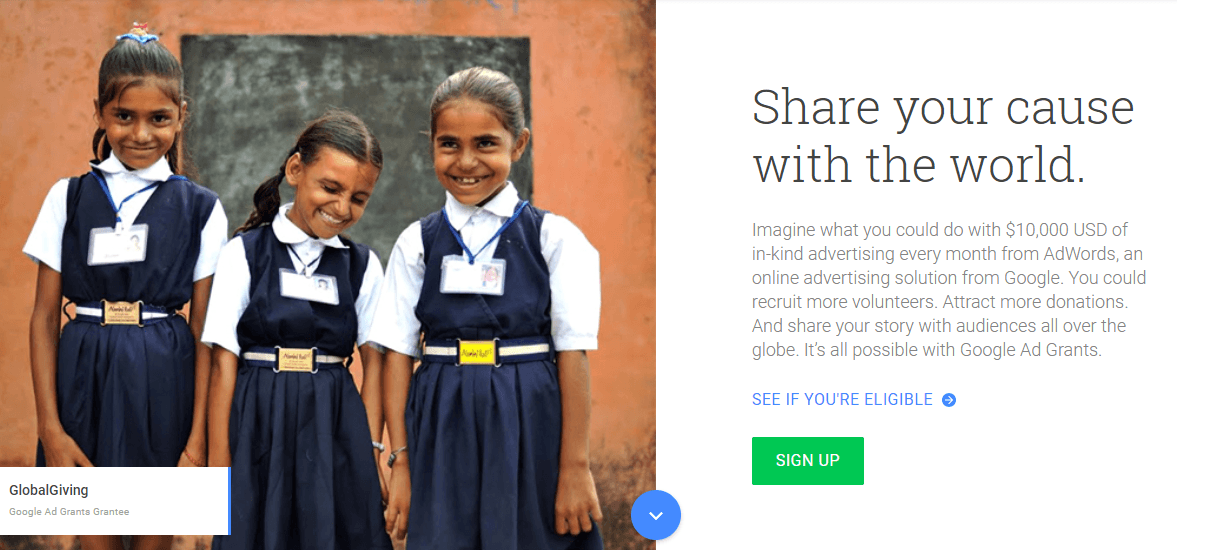
However, what most companies don’t realize, is that Google has a soft spot for nonprofit brands. In fact, the search engine giant provides qualified nonprofits with up to $10,000 per month in Google AdWords spending, which they can use to improve their online presence with PPC. You can use that financial allocation to bid on the keywords that generate the most attention from donor prospects in your niche.
You may still need a marketing expert to help you get the most out of your AdWords spend, but a Google Grant can take a lot of the pressure off. To qualify for a Google grant, your nonprofit must:
- Have a valid charity status
- Agree to the term & conditions Google imposes
- Have a live and regularly-updated website
Alternatively, you can always try a Search advertising platform. In general, they are cheaper than Google ads, so they might be worth testing out
Create as Much Content as Possible
Content is crucial to the success of your nonprofit marketing campaign. In fact, content marketing costs up to 62% less than any other advertising strategy, but it also delivers three times the number of leads.
The more content you generate for your charitable organization, the more your potential donors will learn about you, and the causes you stand for. Content leads to better engagement, enhanced loyalty, and increased virality for your company. Here are a few ideas for how you can create low-cost, useful content:
- Use events as a catalyst to produce case studies about the growth and development of your nonprofit organization.
- Get a visual social media account with a platform like Snapchat or Instagram and share regular videos or photos that demonstrate what goes on “behind the scenes” with your group.
- Write blogs and articles based on what you know about your cause, and the experiences you’ve had as your organization has grown.
- Write about the history of your group, and what you’ve gone through to get to where you are today.
- Reach out to industry influencers and ask them to comment on their experiences with your brand over the years.
Partner with Other Companies
Many for-profit companies build their marketing strategies on an “us against the world” mentality. However, partnerships can be a fantastic way to grow and enhance your professional brand. As a nonprofit organization, you’re in a great position to take advantage of business partnerships, as many companies look for chances to connect with charities so that they can establish a better relationship with their target audience.
Partnerships between local companies and nonprofit organizations are a win-win opportunity. Your charitable group gets better reach for any marketing you can afford to invest in, while the company you partner with enhances their reputation by showing their customers that they care about more than just profits. Just remember to:
- Look for partners with companies that are relevant to your niche. A charity supporting animals might partner with a local vet practice for instance.
- Work with your partner companies to develop your presence on social media. Use promoted posts and hashtags to expand your brand reach.
- Host live events where possible to introduce people to your organization in person. You may even be able to take part in industry conferences and networking events.
Embrace Employee Advocacy
It can be difficult for any brand to consistently come up with immersive and engaging content for their brand. Even if you use the tips outlined above. The good news is that you don’t have to have to pay for a team of writers to help you. Most charitable organizations already have the help they need in the form of their employees.
Employee advocates can speak on behalf of your groups, through blog posts, podcasts, and social media posts, to give potential donors the engaging information they’re looking for. Your advocacy campaigns might include videos taken at charity events, live interviews with nonprofit employees, and speeches from leaders in your organization. To access a successful employee advocacy strategy, you’ll need:
- Incentives and benefits: Happy, supported employees are more likely to go above and beyond for your nonprofit brand. A PEO service can help you to find unique incentives that will turn your people into ambassadors for your company. Whether it’s better health insurance or a few simple money-saving incentives, find ways to delight your team.
- A strategy: Make sure that you have plans in place for how you’d like your team to share information that’s relevant to your brand. Maybe you want to focus heavily on blog posts, or you prefer the idea of social advocacy.
- Support: Ensure that there are solutions in place to empower and support your employees as they support you through advocacy. This might mean giving them social media training sessions or implementing special tools that help them to track their posts. Make advocacy as smooth and natural as possible for your team.
Building Buzz for Your Nonprofit Brand
Marketing any organization is tough, but nonprofits can face some of the most significant challenges when it comes to advertising, thanks to their limited budget. Fortunately, there are plenty of great ways that you can generate attention for your organization without spending much money at all. The four options above offer incredibly low-cost and high-reward ways to establish the buzz that your charitable group needs.
FAQ
How can nonprofits use AI to build brand buzz?
Nonprofits can use AI to brainstorm campaign ideas, write social media posts, repurpose stories, personalize donor outreach, analyze engagement, monitor social conversations, and create faster content workflows. AI helps small teams stay visible without starting from scratch every time.
Why is storytelling important for nonprofit brand awareness?
Storytelling helps people understand the human impact behind a nonprofit’s mission. Strong stories make campaigns more memorable, emotional, and shareable, which can lead to more donations, volunteers, and community support.
What kind of content helps nonprofits create buzz?
Nonprofits can create buzz with impact stories, short videos, volunteer spotlights, donor updates, campaign milestones, behind-the-scenes posts, partner stories, educational content, and clear calls to action. The best content is easy to understand and easy to share.
How can a nonprofit organization effectively build buzz for its brand?
Building buzz for a nonprofit brand involves strategic marketing and engagement efforts to increase awareness and support.
What role does storytelling play in building buzz for a nonprofit brand?
Compelling storytelling helps create an emotional connection with the audience, making the nonprofit’s mission relatable and memorable.
How can nonprofits leverage social media to generate buzz for their brand?
Nonprofits can use social media platforms to share stories, engage with supporters, run campaigns, and spread their message to a wider audience.
What strategies can nonprofits use to create engaging and shareable content that generates buzz?
Creating content that resonates with the target audience, evokes emotions, and provides value can encourage sharing and engagement.
How can partnerships and collaborations with other organizations or influencers help build buzz for a nonprofit brand?
Collaborations extend reach and credibility. Partnering with like-minded organizations or influencers can amplify the nonprofit’s message.
What role does community engagement and involvement play in building buzz for a nonprofit brand?
Engaging the local community through events, volunteer opportunities, and partnerships fosters a sense of belonging and support for the nonprofit.
How can email marketing campaigns be utilized to build buzz and maintain donor relationships for nonprofits?
Email marketing allows nonprofits to keep supporters informed, share updates, and engage donors, contributing to long-term brand buzz.
What is the significance of visual branding elements like logos and design in nonprofit brand building?
Visual branding elements create a recognizable identity and convey the nonprofit’s mission, values, and professionalism.
How can nonprofits effectively measure the impact of their brand-building efforts and adjust their strategies accordingly?
Nonprofits can measure impact through metrics like website traffic, social media engagement, donation trends, and surveys to gather feedback.
What ethical considerations should nonprofits keep in mind while building buzz for their brand?
Nonprofits should maintain transparency, ensure funds are used as intended, protect donor privacy, and avoid deceptive or manipulative tactics in their brand-building efforts.
How can nonprofits use events and fundraisers to create buzz around their brand and mission?
Hosting events and fundraisers allows nonprofits to engage with the community, generate excitement, and raise awareness for their cause.
What are some creative marketing tactics that nonprofits can employ to stand out and build buzz in a crowded digital landscape?
Creative tactics include viral campaigns, interactive content, user-generated content challenges, and leveraging trending topics.
How can nonprofits effectively leverage the power of video content to build buzz for their brand?
Video content, such as documentaries, success stories, and behind-the-scenes footage, can emotionally connect with audiences and generate buzz when shared online.
What is the role of advocacy and grassroots movements in building buzz and support for nonprofit brands?
Advocacy efforts and grassroots movements can mobilize supporters, create a sense of urgency, and garner public attention for a nonprofit’s cause.
How can nonprofit leaders and spokespersons effectively communicate the organization’s mission and values to build brand credibility and trust?
Clear and passionate communication from leaders and spokespersons can convey the nonprofit’s authenticity and dedication to its mission.
What strategies can nonprofits use to engage and retain volunteers and donors who can help amplify their brand message?
Effective engagement strategies include acknowledging contributions, providing updates, and showing appreciation to volunteers and donors.
How can nonprofits adapt their brand-building strategies to align with changing societal values and evolving public perceptions?
Adaptation involves staying attuned to current issues, addressing emerging challenges, and demonstrating relevance and responsiveness.
What is the role of data analytics and feedback analysis in refining nonprofit brand-building strategies?
Data analytics and feedback analysis provide insights into what strategies are working, enabling nonprofits to refine and optimize their brand-building efforts.
How can nonprofit organizations harness the power of storytelling through the voices and experiences of beneficiaries to build brand empathy and support?
Sharing authentic stories from beneficiaries can humanize the nonprofit’s mission and inspire empathy, connecting donors and supporters to the cause.
What resources and networks are available for nonprofits seeking guidance and support in building buzz for their brand?
Nonprofits can access resources from industry associations, engage with nonprofit marketing agencies, and join networks of like-minded organizations for advice and support.
Author Bio:
Jock Purtle an entrepreneur with years of experience growing and developing highly successful companies. He’s the Founder of Digital Exits and when he’s not running his own companies, Jock loves sharing his insights with other aspiring business owners.
Other related articles
Check out our latest Content
Articles, Images, Videos, and more!
Get a Christian Coloring Book this Christmas
Never get Stuck – Ask the AI Buddy Anything
Convert Text into any Case
Pros and Cons of Shopping
Epic YT Title Examples
Earn $2000 a month!
Latest Videos